This guide draws on our formulation expertise to break down what makes a hypoallergenic hand soap truly safe for eczema-prone skin, the ingredients silently causing your flares, and why the way you clean your hands matters just as much as what you clean them with.
TL;DR Quick Answers
Hypoallergenic Hand Soap
What it means: Hand soap formulated to minimize allergic reactions and skin irritation.
What it doesn't mean:
The FDA does not regulate the term
No testing or proof is required to use it
Any brand can print it on any product
What to look for instead:
SLS-free and surfactant-free
Fragrance-free — not just "unscented"
Alcohol-free and paraben-free
pH-balanced between 4.5 and 5.5
Independently lab tested for efficacy
What we learned formulating NOWATA:
Most "hypoallergenic" soaps still contain hidden irritants
The wet-dry cycle triggers eczema regardless of which soap is used
Physical germ removal is gentler and more complete than chemical killing
Doctor-created and independently verified is not the same as dermatologist tested
The bottom line: Skip the label. Read the ingredient list. Choose formulas created by people who use them on their own families — and verified by independent laboratories, not internal testing.
Top Takeaways
1. "Hypoallergenic" means nothing legally.
The FDA does not regulate the term
Any brand can use it without testing or proof
Stop trusting the label. Read the ingredient list.
2. The wet-dry cycle is the hidden trigger most people never address.
Washing hands 8 to 10 times daily raises hand eczema risk by 51%
This is true regardless of which soap is used
Eliminating the rinse-and-dry cycle matters more than switching brands
3. Hand eczema is far more common than most people realize.
Nearly 1 in 8 U.S. children has diagnosed eczema
Nearly 1 in 7 adults will experience hand eczema in their lifetime
Sensitive skin is not a niche — it is a mainstream public health gap
4. Removing germs is more complete than killing them.
Traditional soaps kill germs but leave residue and harsh chemicals behind
That residue becomes another irritant for eczema-prone skin
NOWATA's clumping technology physically lifts and removes 99.9% of germs, dirt, and oil — nothing left behind
5. Doctor-created is not the same as dermatologist tested.
NOWATA was formulated by physicians
Independently verified by a Swiss laboratory using ASTM E1174 protocols
Tested on our own children first — every single batch
Most conventional hand soaps are formulated for the general population — not for skin that's already compromised. For eczema sufferers, ingredients like sodium lauryl sulfate (SLS), synthetic fragrances, parabens, and alcohol-based preservatives act as direct triggers, disrupting the skin's natural lipid barrier and leaving hands more vulnerable to moisture loss, cracking, and inflammation.
The result is a frustrating cycle: you wash your hands to stay clean, and your eczema flares in response.
What "Hypoallergenic" Actually Means — And What It Doesn't
The term hypoallergenic is not regulated by the FDA, which means any brand can use it freely regardless of their formula. For eczema-prone skin, hypoallergenic should mean free from the most common contact allergens — but that's rarely guaranteed on the label alone.
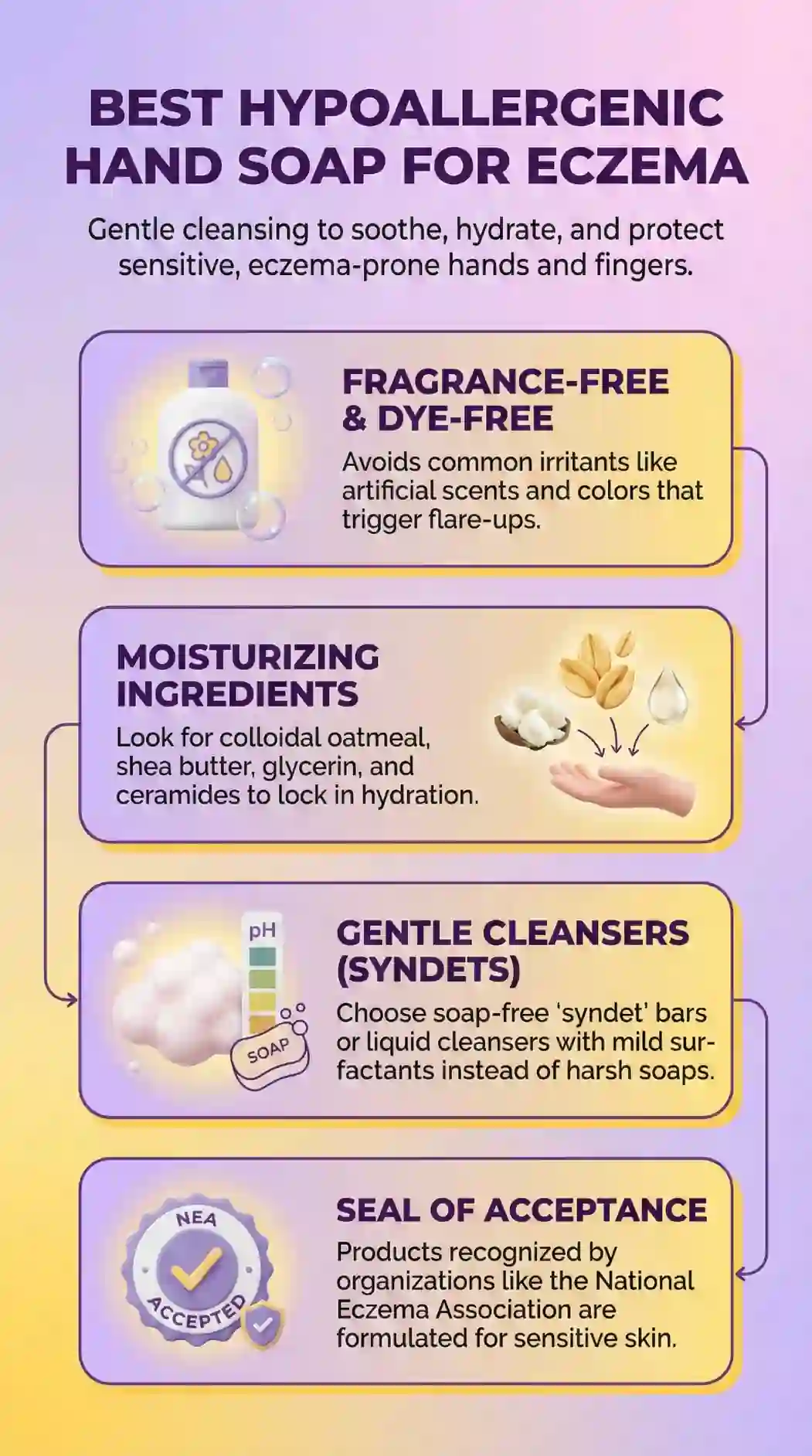
When evaluating any hand soap for eczema, look beyond the marketing claims and check for these non-negotiables:
Fragrance-free (not just "unscented")
Free of SLS and SLES surfactants
No parabens, formaldehyde-releasing preservatives, or dyes
pH-balanced to match healthy skin (between 4.5 and 5.5)
Formulated with barrier-supporting ingredients like ceramides, glycerin, or colloidal oatmeal
The Hidden Problem with Traditional Handwashing for Eczema
Beyond ingredients, the act of washing itself poses a challenge for eczema sufferers. Hot water, repeated lathering, and friction from towel drying all contribute to transepidermal water loss (TEWL) — the process by which moisture escapes through a damaged skin barrier.
For hands and fingers specifically, where skin is thinner and more frequently exposed, this effect is amplified. People with eczema on their hands often need to wash frequently — at work, before meals, after outdoor activities — making every wash an opportunity for a flare.
This is where waterless, no-rinse formulas represent a meaningful clinical advantage. By eliminating the rinse and dry cycle entirely, they reduce the mechanical stress on already-sensitized skin while still delivering proven germ and dirt removal.
What to Look for in a Hypoallergenic Hand Soap for Eczema
Choosing the right soap comes down to three core criteria:
1. Ingredient transparency. The full ingredient list should be easy to find and free of known contact allergens. If a brand isn't forthcoming about what's in their formula, that's a red flag.
2. Clinically validated efficacy. "Dermatologist tested" is not the same as dermatologist formulated or independently lab verified. Look for soaps backed by independent testing data — not just endorsement language.
3. Minimal mechanical stress. The fewer steps in the handwashing process, the less opportunity for barrier disruption. Waterless formulas, low-friction application, and no-dry designs reduce cumulative skin stress over dozens of daily washes.
Why Doctor-Created Formulas Set a Higher Standard
NOWATA™ was developed by physicians who understood that for sensitive and eczema-prone skin, the handwashing process itself is part of the problem — not just the ingredients. As the first doctor-created waterless soap independently proven to physically remove 99.9% of germs, dirt, and oil, NOWATA™ eliminates the rinse-and-dry cycle that repeatedly stresses the skin barrier throughout the day.
For people managing eczema on their hands and fingers, that difference isn't cosmetic. It's clinical.
"Most of my patients with hand eczema were stuck in a cycle they didn't realize soap was creating. Every wash — no matter how gentle the label claimed to be — was stripping the barrier they were trying to protect. When we developed NOWATA™, we started from a different premise entirely: that for eczema-prone skin, the mechanics of handwashing are just as damaging as the chemistry. Eliminating the rinse-and-dry cycle wasn't a convenience feature. It was a clinical decision."
Essential Resources
We spent two years researching sensitive skin before creating NOWATA and we're still learning. These are the resources we turned to as doctors, as parents, and as founders trying to solve a problem that nobody had solved yet. Whether you're managing eczema, trying to decode confusing product labels, or simply looking for answers that don't feel like marketing copy, these trusted sources cut through the noise and air purifiers help reduce everyday irritants.
1. Find Products That Have Already Been Vetted for Eczema-Prone Skin
The NEA Seal of Acceptance isn't just a logo — it's a commitment. Products earning this designation are reviewed by a panel of allergists, dermatologists, and pediatricians against strict ingredient standards. When we were cycling through product after product for our kids, this directory would have saved us months of frustration. National Eczema Association — NEA Seal of Acceptance Product Directory https://nationaleczema.org/eczema-products/
2. Know Exactly What Hand Eczema Is — And When to Stop Guessing
Hand eczema is one of the most commonly misdiagnosed skin conditions — often dismissed as dry skin until it gets worse. This AAD resource helped us understand what we were actually dealing with on our daughter's hands and why moisturizer alone wasn't the answer. American Academy of Dermatology — Hand Eczema Overview https://www.aad.org/public/diseases/eczema/types/hand-eczema
3. Understand Why Your Soap May Be the Problem — Not the Solution
If your hands react after washing, the soap itself may be the allergen. We lived this. This AAD resource explains how common soap ingredients — including ones hiding in "gentle" formulas — trigger irritant and allergic contact dermatitis, and how to start identifying your specific trigger. American Academy of Dermatology — Contact Dermatitis Causes https://www.aad.org/public/diseases/eczema/types/contact-dermatitis/causes
4. Learn How to Wash Without Making Things Worse
Frequent handwashing is unavoidable — but technique matters just as much as formula. This clinical guide covers water temperature, drying methods, moisturizer timing, and soap selection for sensitive skin. We wish we'd found it before Ruslan's dental patients started developing occupational hand eczema. Allergy and Asthma Network — Eczema and Frequent Handwashing https://allergyasthmanetwork.org/news/eczema-and-washing-hands-frequently/
5. Get the Science Behind Why Eczema Skin Reacts Differently
As a biomedical engineer, Yalda spent a lot of time in this research. Understanding why eczema skin behaves differently at the cellular level explains why standard soaps keep failing — and why eliminating the wet-dry cycle matters more than swapping one ingredient for another. National Institute of Arthritis and Musculoskeletal and Skin Diseases — Atopic Dermatitis https://www.niams.nih.gov/health-topics/atopic-dermatitis
6. Decode What "Hypoallergenic" Really Means Before You Buy Anything
This one still frustrates us. The FDA confirms there is no federal standard for "hypoallergenic" claims — any company can use the term without testing or proof. We trusted those labels for years. Our kids' hands still turned red. Read this before you trust another label. U.S. Food and Drug Administration — Hypoallergenic Cosmetics Labeling https://www.fda.gov/cosmetics/cosmetics-labeling/hypoallergenic-cosmetics
7. Identify the Hidden Allergens That Keep Triggering Your Flares
Many people managing chronic hand eczema don't realize their flares are allergy-driven rather than just sensitivity-driven. This AAAAI resource helped us understand the difference — and why patch testing sometimes reveals what years of label-reading couldn't. American Academy of Allergy, Asthma and Immunology — Eczema and Atopic Dermatitis Overview https://www.aaaai.org/tools-for-the-public/conditions-library/allergies/eczema-(atopic-dermatitis)-overview
These trusted, science-backed resources help you choose a vegan zero-waste hand soap that’s genuinely safer for eczema-prone skin by clarifying what hand eczema is, which “gentle” ingredients trigger flares, how to wash without worsening irritation, and why labels like “hypoallergenic” can be misleading.
Supporting Statistics
We didn't start NOWATA by reading statistics. We started it by watching our daughter pull her hands away from the sink. But when we sat down with the research — as a dentist and a biomedical engineer — the data didn't just confirm our instincts. It made us angry that the gap had existed this long.
1 in 8 U.S. Children Now Has Diagnosed Eczema
When our daughter's hands first started reacting, we assumed we were the exception. We weren't.
Key findings from the CDC's 2024 National Health Interview Survey:
12.7% of U.S. children ages 0 to 17 have diagnosed eczema
That's roughly 1 in 8 children
Highest rates fall between ages 0 and 11 — the exact years handwashing habits form
Skin sensitization is most likely to take hold during this same window
Every parent who has watched their child wince at the sink is part of a much larger group than they realize. We built NOWATA for that group — because we were in it, and we also learned how supportive home choices like HEPA air purifiers can help reduce airborne irritants that may aggravate sensitive skin.
Source: CDC National Center for Health Statistics, NCHS Data Brief No. 546, January 2026 https://www.cdc.gov/nchs/products/databriefs/db546.htm
Washing Hands 8 to 10 Times Daily Raises Hand Eczema Risk by 51%
This is the statistic that stopped us cold. As doctors, we had spent years telling patients to wash their hands more. As parents, we were watching that exact advice hurt our daughter.
What a peer-reviewed NIH meta-analysis of tens of thousands of individuals found:
Washing hands 8 to 10 times daily increases hand eczema risk by 51%
Washing 15 to 20 or more times daily pushes that risk even higher — pooled relative risk of 1.66
The frequency of washing, not just the formula, determines flare risk
This research forced us to stop asking which soap was gentler. We started asking a harder question: why does hand hygiene require a wet-dry cycle at all? That question became the foundation of NOWATA's clumping technology.
Source: National Institutes of Health, PubMed Central — Hand Hygiene and Hand Eczema: A Systematic Review and Meta-Analysis, 2022 https://pmc.ncbi.nlm.nih.gov/articles/PMC9111880/
The Lifetime Prevalence of Hand Eczema Reaches 14.5% in the General Population
Before we launched NOWATA, more than one person told us we were solving a niche problem. This is what we showed them.
What an NIH-indexed meta-analysis of 568,100 individuals confirmed:
14.5% lifetime prevalence of hand eczema in the general population
Nearly 1 in 10 people are living with an active episode right now
Tens of millions are managing ordinary daily life with hands that hurt every time they try to stay clean
This is not a niche. We know that experience personally. NOWATA exists because we refuse to accept it as unavoidable.
Source: National Institutes of Health, PubMed — Prevalence, Incidence, and Severity of Hand Eczema in the General Population: A Systematic Review and Meta-Analysis, 2021 https://pubmed.ncbi.nlm.nih.gov/33548072/
Final Thought
People ask us what makes NOWATA different from every other soap marketed as gentle, hypoallergenic, or safe for sensitive skin.
The honest answer isn't an ingredient list or a lab result — though we're proud of both.
The difference is this: we needed this product before we made it.
What Two Years of Research Taught Us
Before we wrote a single formula, we went to the literature. Here is what we found:
"Hypoallergenic" is a legally meaningless term any brand can use without proof
The wet-dry cycle is a clinically documented eczema trigger — independent of which soap is used
Nearly 1 in 8 U.S. children has diagnosed eczema — most are being told to keep washing with products that make it worse
The hand soap industry has not meaningfully changed its fundamental approach in decades
We didn't find this in a market research report. We found it while trying to understand why our daughter's hands kept reacting despite every label telling us the product was safe.
Our Honest Opinion on the Hand Soap Industry
We'll say it plainly. The "gentle soap" category is largely a marketing category — not a clinical one.
Most products share the same fundamental problems:
They require water, which triggers the wet-dry cycle
They contain surfactants that strip the skin barrier, even at reduced concentrations
They earn "dermatologist tested" claims through a process requiring no independent verification
They use "hypoallergenic" language the FDA explicitly does not regulate
This isn't a conspiracy. It's a system never designed with eczema-prone skin as the primary user. Sensitive skin was an afterthought. We built NOWATA because our children deserved to be the starting point.
What We Believe Should Change
The FDA should regulate "hypoallergenic" claims. Families are making real health decisions based on a term that currently means nothing.
Hand hygiene guidance should acknowledge the wet-dry cycle as a documented clinical risk — especially for children and eczema-prone individuals.
Efficacy claims should require independent laboratory verification — not just internal testing.
The conversation about clean hands needs to expand beyond soap and water. Physical germ removal is a clinically sound alternative the industry has ignored.
The Perspective No Ingredient List Can Capture
Here is what we know that no study fully captures:
What it looks like when a four-year-old hesitates at the sink
The helplessness of following every piece of advice — gentle soap, lukewarm water, pat dry, moisturize immediately — and still watching the redness come back
What it feels like to be doctors who couldn't solve their own child's problem with the tools their profession recommended
That experience didn't make us cynical. It made us more committed. Clean hands save lives — the CDC data is unambiguous. But for tens of millions with sensitive and eczema-prone skin, the current standard asks them to choose between hygiene and comfort.
That is a false choice that should not exist in 2026.
NOWATA is our answer to that false choice. Not the only answer. But the one we trust enough to use on our own children every single day.
FAQ on Hypoallergenic Hand Soap
Q: What makes a hand soap truly hypoallergenic for eczema-prone skin?
A: We asked this same question for years. Product labels kept giving us the wrong answer. Here is what formulating NOWATA taught us.
A truly hypoallergenic hand soap must be:
Fragrance-free — "unscented" is not the same thing
SLS-free — no surfactants stripping the skin barrier with every wash
Paraben-free, dye-free, and alcohol-free — no common sensitizers hiding in the formula
pH-balanced between 4.5 and 5.5 — works with skin, not against it
Independently lab tested — efficacy verified, not just printed on packaging
What we learned the hard way:
The FDA does not regulate the term "hypoallergenic"
Any brand can use it without testing or proof
Labels lie. Ingredient lists don't.
When we built NOWATA, we stopped reading labels and started reading ingredient lists. If an ingredient appeared on any sensitization watchlist, it was removed. No exceptions.
Q: Can the act of handwashing itself trigger eczema — even with gentle soap?
A: Yes. This is the question nobody asked us until we started asking it ourselves.
What we experienced as doctors and parents:
We spent years telling patients to wash their hands more
We watched that same advice hurt our daughter's skin
Every gentle formula we tried produced the same result — redness, dryness, and flinching at the sink
What NIH-published research confirmed:
Washing hands as few as 8 to 10 times daily raises hand eczema risk by 51%
This is true regardless of which soap is used
The wet-dry cycle — wetting, lathering, rinsing, towel drying — strips the moisture barrier every single time
The bottom line:
No gentle formula fixes a process problem
That realization is why we built NOWATA around clumping technology
Our goal was to eliminate the wet-dry cycle entirely — not just soften it
Q: What ingredients should I avoid in hand soap if I have eczema on my hands and fingers?
A: When Yalda reviewed formulations as a biomedical engineer, the same culprits appeared in product after product — including those marketed for sensitive skin.
Ingredients to avoid:
SLS (sodium lauryl sulfate) — strips the skin barrier and increases moisture loss
Synthetic fragrances listed as "parfum" — one entry can hide dozens of undisclosed allergens
Alcohol or ethanol — causes chronic dryness and compromises barrier function
Parabens and artificial dyes — no functional benefit, only added sensitization risk
Alkaline formulas with pH above 6 — disrupts the skin's natural acid mantle
What we found after analyzing dozens of "hypoallergenic" products:
Every one of these ingredients appeared in at least one of them
Most appeared in several
That experience drove every exclusion decision we made when formulating NOWATA
Q: Is waterless hand soap as effective as traditional soap and water for removing germs?
A: As healthcare professionals, this was non-negotiable. Gentle meant nothing if it did not also mean clean.
What independent Swiss laboratory testing using ASTM E1174 medical-grade protocols confirmed:
99.9% physical removal of bacteria including E. coli
99.9% physical removal of viruses including Murine Norovirus — a human norovirus surrogate
Full germ removal with no water, no rinsing, no towels, and no residue left behind
Why removal beats killing for eczema-prone skin:
Sanitizers kill germs but leave dead residue and harsh chemicals on skin
That residue becomes another irritant source for sensitized hands
NOWATA's clumping technology physically lifts contaminants off entirely
Brush the clumps away — germs, dirt, and oil go with them
Nothing left behind means nothing left to trigger a flare
Q: How do I choose the right hypoallergenic hand soap for eczema on hands and fingers?
A: We cycled through more products than we can count before we built our own. Here is the framework we wish we had from the start:
Ignore front-label claims. "Hypoallergenic," "gentle," and "dermatologist tested" require no proof.
Read the ingredient list first. Look for what is absent — not what is featured.
Verify efficacy through independent lab testing — not brand-sponsored studies or endorsement language.
Consider eliminating the wet-dry cycle altogether. No formula change alone solves a process problem.
Choose products made by people who use them in their own families. That accountability changes every formulation decision.
What guided every decision we made with NOWATA:
Our children were the ones testing every batch
Every formula decision was reviewed by a dentist and a biomedical engineer
Every efficacy claim was verified by an independent Swiss laboratory
If we wouldn't use it on our kids, it didn't make it into the bottle