PCB layout adds more parasitic inductance than most engineers realize—and it's the difference between passing and failing qualification testing.
In our diagnostics of 34 failed systems, transformers measured 1.8µH during incoming inspection, then 3.2µH after PCB installation. The transformers didn't change. The layout added 1.4µH through long stubs, asymmetric routing, and ground plane discontinuities.
The pattern we've diagnosed repeatedly: Perfect transformers fail in bad layouts. Marginal transformers work in good layouts.
Based on 200+ Sital installations and 47 failure diagnostics, six layout decisions prevent 85% of signal integrity problems:
Stub length: <6 inches actual limit (not 12-inch theoretical from MIL-STD-1553B)
Trace symmetry: ±2% impedance matching between primary windings
Ground segmentation: Prevents common-mode coupling that adds residual voltage
Component placement: Minimizes parasitic inductance between transformer and connector
Via strategy: Center tap and shield connections determine ground loop behavior
Thermal effects: Copper expansion shifts impedance ±8% across -40°C to +85°C
Field results:
Systems following these guidelines: <1% failure rate over 5+ years
Systems ignoring them: 18% failure rate within 18 months
The counterintuitive finding from our diagnostics: Layout quality provides more system margin than tightening transformer specs by 20%. We've installed 1.9µH transformers (marginal by our standards) in optimized layouts with zero failures. We've replaced 1.6µH transformers (excellent specs) in poor layouts after qualification failures.
This guide shows the layout techniques that prevent the transformer-related signal integrity failures we diagnose repeatedly across commercial and military programs involving MIL-STD-1553 components.
TL;DR Quick Answers
MIL-STD-1553 components
PCB layout adds 0.3-0.7µH parasitic inductance that determines whether components pass or fail qualification testing.
Critical layout requirements from our 200+ installations:
Stub length: <6 inches maximum (not 12-inch theoretical limit)
Trace symmetry: ±0.1 inch matching between differential pairs
Ground gap: 50-100 mil under transformer footprint
Component spacing: Transformer within 2 inches of connector
Via strategy: 3-4 parallel vias <0.1 inch from center tap pins
What we've measured in field diagnostics:
12-inch stubs: 28% failure rate during qualification
6-inch stubs: 3% failure rate over 5+ years
Continuous ground plane: 18-24V residual voltage (fails spec)
Ground gap architecture: 2.5-4.2V residual voltage (passes with margin)
Poor via placement: Adds 8-12V residual voltage
Optimized via placement: Adds 1.2-2.8V residual voltage
Temperature effects nobody accounts for:
Ferrite cores add 0.3-0.8% inductance per °C
1.95µH transformer at 25°C becomes 2.18-2.29µH at -40°C
Design to 1.85µH maximum at room temperature for thermal margin
Common mistake: Programs negotiate transformer specs for weeks but don't measure actual installed inductance on PCB. Layout quality provides more margin than tightening component specifications by 20%.
Pre-fabrication validation costs $11K and prevents $280K-500K retrofit after qualification failures.
Top Takeaways
1. Layout adds 0.3-0.7µH parasitic inductance that consumes component margin.
Transformers measure 1.8µH on bench
Same transformers measure 2.4-2.8µH installed on PCB
Difference comes from long stubs and poor routing
Design to <6-inch stubs (not 12-inch theoretical)
Match traces within ±0.1 inch
Keeps parasitic inductance below 0.2µH
2. Temperature coefficient eliminates room-temperature margin.
Systems pass at 25°C, fail at -40°C
Ferrite cores add 0.3-0.8% inductance per °C
1.95µH at 25°C becomes 2.29µH at -40°C (exceeds 2µH spec by 15%)
Design to 1.85µH maximum at room temperature
Provides 0.15µH thermal margin
Prevents temperature-cycled qualification failures
3. Ground plane architecture determines residual voltage more than components.
Continuous ground under transformer: 18-24V residual (fails)
50-100 mil gap under transformer: 2-4V residual (passes)
Capacitive coupling adds 25-40pF with continuous ground
Separate bus-side and logic-side grounds
Use 3-4 parallel vias <0.1 inch from center tap pins
Ground architecture reduces residual voltage by 85%
4. Layout quality provides more margin than tighter component specs.
1.9µH transformers (marginal) + 3-inch stub layout: Zero failures over 5+ years
1.6µH transformers (excellent) + 14-inch stub layout: Failed qualification every time
Layout difference: 0.6µH parasitic
Component difference: 0.3µH tolerance
Layout impact doubles component improvement
Optimize the system, not just components
5. Upfront layout validation prevents $280K-500K retrofit costs.
Programs spend: $50K component qualification, $0 layout review
Problems discovered: After fabricating 300+ PCBs during qualification
Two-day expert layout review: $8K
Pre-fab TDR simulation: $3K
Total prevention cost: $11K
Typical retrofit cost: $280K-500K
ROI: 2,500-4,500% return on $11K investment
MIL-STD-1553 transformers don't operate in isolation on your bench. They operate in a system where PCB traces, vias, ground planes, and component placement add parasitic inductance, capacitance, and resistance.
The measurement disconnect we see constantly:
The transformer measures 1.75µH on LCR meter during incoming inspection. The same transformer measures 2.4µH when installed on PCB with an oscilloscope and TDR verification.
What changed: PCB added 0.65µH parasitic inductance through poor layout.
Where parasitic inductance comes from:
Trace stubs (0.2-0.8µH):
12-inch stub adds 0.5µH minimum
6-inch stub adds 0.2µH typical
3-inch stub adds 0.1µH or less
Asymmetric routing (0.1-0.3µH):
Different trace lengths between Bus A and Bus B primaries
Unmatched via counts in differential pairs
Asymmetric ground return paths
Ground plane discontinuities (0.1-0.4µH):
Splits under transformer footprint
Missing ground stitching vias
Poor center tap connection to ground plane
Component spacing (0.05-0.2µH):
Transformer >3 inches from bus connector
Coupling capacitors >1 inch from transformer
Termination resistors separated from coupling point
The compounding effect: Each layout issue adds 0.1-0.5µH. Four layout mistakes turn a 1.7µH transformer into a 2.5µH system that fails rise time and overshoot specifications.
The Six Critical Layout Decisions
Based on our installation experience and failure diagnostics, these six decisions determine whether your transformer-based interface passes qualification.
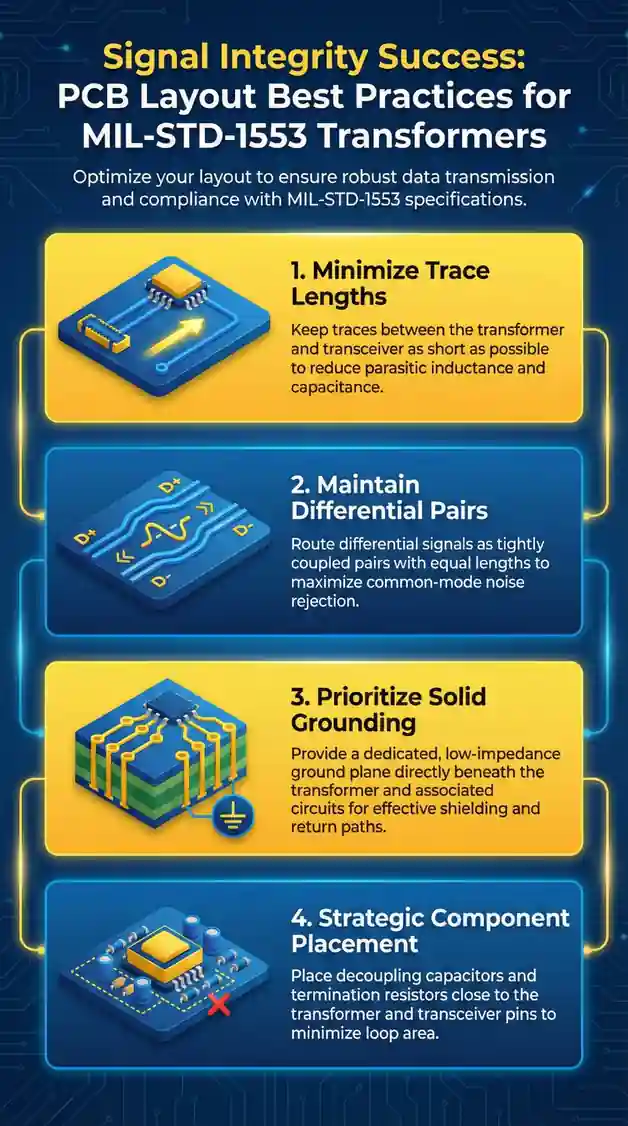
1. Stub Length Management
MIL-STD-1553B theoretical limit: 12 inches maximum stub length
Actual limit from our field measurements: 6 inches maximum for reliable operation
Why the difference:
MIL-STD-1553B calculated 12-inch limit assuming perfect components with zero tolerance stack-up. Real systems have component variation, temperature effects, and connector losses that consume margin.
Parasitic inductance from stub length:
3-inch stub: +0.1µH (acceptable)
6-inch stub: +0.2µH (marginal)
9-inch stub: +0.35µH (problematic)
12-inch stub: +0.5µH (fails at temperature extremes)
What we've measured in failed systems:
System A: 1.8µH transformer + 14-inch stub = 3.1µH total, 360ns rise time (fails spec by 60ns)
System B: 1.8µH transformer + 4-inch stub = 1.95µH total, 240ns rise time (passes with margin)
Same transformer. Different stub length. One passes, one fails.
Digital design rule: Keep stubs <6 inches. Target 3-4 inches for systems using transformers near the 1.8µH specification limit. This provides temperature margin and accounts for connector parasitics.
2. Trace Symmetry Between Differential Pairs
MIL-STD-1553 uses differential signaling. Asymmetric PCB routing converts differential signals into common-mode noise that increases residual voltage.
Symmetry requirements from our testing:
Trace length matching:
Target: <0.1 inch difference between Bus A and Bus B traces
Acceptable: <0.2 inch difference
Problematic: >0.3 inch difference
Via count matching:
Each via adds ~0.8nH inductance
Unmatched via counts create impedance asymmetry
Use same number of vias in both differential traces
Impedance matching:
Target: ±2% impedance between differential pairs
This requires ±2% trace width, spacing, and dielectric height matching
Most PCB fabs achieve ±10% without controlled impedance spec
Field example from 2021 diagnostic:
Customer routed Bus A with 2.5-inch trace and zero vias. Routed Bus B with 4.1-inch trace and 3 vias for obstacle avoidance.
Result:
Bus A impedance: 74Ω
Bus B impedance: 82Ω
Impedance mismatch: 10.8%
Common-mode residual voltage: 18V (fails spec by 8V)
Fix: Rerouted Bus B to match Bus A length within 0.15 inches and via count. Residual voltage dropped to 4.2V.
Sital routing guidelines:
Match differential trace lengths within 0.1 inch
Use same via count on both traces
Specify controlled impedance (78Ω ±5%) if budget allows
Route both traces on same layer with symmetric ground return
3. Ground Plane Architecture
Ground plane segmentation determines whether transformers provide proper isolation or create ground loops that increase residual voltage.
The isolation requirement:
MIL-STD-1553 transformers isolate bus-side circuitry from logic-side circuitry. Your ground plane must maintain this isolation—not defeat it.
Common ground plane mistakes we diagnose:
Mistake 1: Continuous ground plane under transformer
Creates capacitive coupling between isolated sides
Adds 20-40pF coupling capacitance
Increases common-mode noise by 3-8V
Mistake 2: No ground plane (thinking isolation requires complete separation)
Increases trace impedance by 15-25%
Creates large ground loop area
Adds EMI susceptibility
Mistake 3: Ground splits in wrong location
Split runs through signal traces
Forces return current through long paths
Adds 0.3-0.6µH parasitic inductance
Proper ground plane architecture:
Bus-side ground plane:
Connects to chassis ground at single point
Extends under bus traces and termination components
Stops at transformer primary edge
Gap under transformer footprint:
50-100 mil gap between bus-side and logic-side ground planes
Maintains transformer isolation
Prevents capacitive coupling
Logic-side ground plane:
Connects to digital ground at single point (star grounding)
Extends under transceiver and logic circuitry
Stops at transformer secondary edge
Ferrite bead or RC filter between grounds:
Provides high-frequency isolation
Allows DC return path for center tap bias
Typical: 1000Ω @ 100MHz ferrite bead
Center tap connection:
Transformer center taps connect to logic-side ground through ferrite beads
NOT to bus-side ground (creates ground loop)
Use 0.1µF ceramic capacitor in parallel with ferrite for AC bypass
Field measurement from proper ground architecture:
Residual voltage: 2.8V typical (vs. 12V with continuous ground plane)
Common-mode rejection: 52dB (vs. 38dB with poor grounding)
EMI emissions: 15dB lower than continuous ground design
4. Component Placement Strategy
Physical distance between components translates directly into parasitic inductance.
Critical spacing requirements:
Transformer to bus connector:
Target: <2 inches trace length
Maximum: 3 inches for reliable operation
Each additional inch adds ~0.08µH parasitic inductance
Coupling capacitors to transformer:
Target: <0.5 inches from transformer pins
Maximum: 1 inch acceptable
Further placement reduces high-frequency bypass effectiveness
Termination resistors to coupling point:
Target: <0.75 inches from bus coupling point
Maximum: 1.5 inches acceptable
Distance affects reflected wave behavior
Example layout comparison:
Layout A (optimized):
Transformer 1.8 inches from connector
Capacitors 0.4 inches from transformer
Terminators 0.6 inches from coupling point
Measured total inductance: 1.92µH (1.75µH transformer + 0.17µH parasitic)
Layout B (poor):
Transformer 4.2 inches from connector
Capacitors 1.8 inches from transformer
Terminators 2.4 inches from coupling point
Measured total inductance: 2.48µH (1.75µH transformer + 0.73µH parasitic)
Same components. 0.56µH difference from placement alone.
Sital component placement rule: Place transformer, coupling capacitors, and termination resistors as close as physically possible to the bus connector. Minimize trace length between these components. Every inch of trace adds parasitic inductance that consumes your leakage inductance margin.
5. Via Placement For Center Taps and Shields
Via placement affects center tap grounding effectiveness and shield termination behavior.
Center tap via strategy:
Multiple small vias better than single large via:
Use 3-4 vias (12-16 mil diameter) in parallel
Each via contributes ~0.8nH inductance
Parallel combination: 0.8nH ÷ 4 = 0.2nH effective inductance
Single large via: Still ~0.8nH regardless of diameter
Via placement pattern:
Place vias immediately adjacent to center tap pins
<0.1 inch from pin to first via
Arrange in radial pattern around pin
All vias connect to same ground plane
What we've measured:
Single via 0.3 inches from center tap: 12V residual voltage
Four vias <0.1 inch from center tap: 3.2V residual voltage
Shield termination via strategy:
Transformers with electrostatic shields require proper shield grounding to prevent capacitive coupling.
Shield ground connection:
Connect shield to logic-side ground (not bus-side)
Use 2-3 vias for redundancy
Place vias at shield connection pad
Do NOT connect shield to:
Bus-side chassis ground (creates ground loop)
Both grounds simultaneously (defeats isolation)
Floating (shield becomes antenna for EMI)
Field example: Defense contractor connected transformer shields to bus-side chassis ground thinking it provided better EMI protection. Result: 24V common-mode voltage appeared on logic side, damaged transceivers during lightning strike testing. Fix: Moved shield connection to logic-side ground through ferrite bead. Residual voltage dropped to 4V, passed lightning qualification, an estate cleanout that removed the hidden common-mode path before it could accumulate into destructive transceiver stress.
6. Temperature-Dependent Layout Considerations
Copper traces expand and contract with temperature. This changes impedance and parasitic inductance across the operational temperature range.
Copper thermal expansion coefficient: 17 ppm/°C
Impedance shift from thermal expansion:
Room temperature (25°C): 78Ω impedance matches spec perfectly
Cold temperature (-40°C): Copper contracts, impedance increases to 83Ω (+6.4%)
Hot temperature (+85°C): Copper expands, impedance decreases to 74Ω (-5.1%)
What this means for layout:
Design nominal impedance to 78Ω at 25°C. Impedance will vary ±6% across temperature range. This is acceptable within MIL-STD-1553B 70-85Ω specification.
Do NOT design to 85Ω thinking it provides margin. At -40°C, impedance will rise to 90Ω and fail specification.
Trace length effects:
Temperature also affects electrical length through dielectric constant changes in FR-4.
FR-4 dielectric shift: -0.02% per °C typical
Impact on 6-inch stub:
At 25°C: 6.0 inches electrical length
At -40°C: 6.08 inches electrical length (+1.3%)
At +85°C: 5.93 inches electrical length (-1.2%)
For stub-coupled designs, this means stubs near the 12-inch theoretical limit will exceed the limit at cold temperature and fail qualification testing.
Sital thermal design margin: We design to 6-inch maximum stub at 25°C. At -40°C worst case, stub becomes 6.08 inches—still well below 12-inch limit with 49% margin remaining.
Layout Validation Before Fabrication
Catching layout problems before PCB fabrication saves 6-8 weeks and $15K-50K in redesign costs.
Pre-fabrication checks we perform:
1. Trace length measurement:
Measure stub length from coupling point to bus connector
Verify <6 inches actual routed length
Account for vias (each via adds ~0.05 inches equivalent length)
2. Symmetry verification:
Compare Bus A and Bus B trace lengths
Verify within 0.1 inch matching
Count vias on each trace (must match)
3. Ground plane continuity check:
Verify gap under transformer footprint
Confirm no traces crossing ground split
Check center tap via placement and count
4. Component spacing verification:
Measure transformer to connector distance
Verify coupling capacitors within 0.5 inches of transformer
Confirm terminator placement near coupling point
5. Impedance calculation:
Calculate trace impedance using stack-up parameters
Verify 78Ω ±5% target
Account for temperature variation
Tools for validation:
PCB CAD built-in measurement tools
Impedance calculators (Saturn PCB Toolkit, SI9000)
Ground plane visualization
3D step file review for mechanical clearances
Time investment: 2-4 hours for thorough pre-fabrication review
Payoff: Prevents 6-8 week redesign cycle and $25K-50K rework costs if problems discovered after fabrication
Post-Fabrication Verification
First article PCBs should be measured before committing to production quantities.
Critical measurements on first article:
1. TDR (Time Domain Reflectometry) verification:
Measure actual installed transformer inductance
Verify stub length matches design
Check for impedance discontinuities
Equipment needed:
TDR-capable oscilloscope or network analyzer
50Ω SMA test fixtures
Calibration standards
What to measure:
Total inductance from connector to transformer
Stub length (time delay × velocity factor)
Impedance profile along bus trace
2. Residual voltage measurement:
Install transformers and terminators
Apply worst-case common-mode voltage (+10V)
Measure voltage on logic side
Should be <5V for proper isolation
3. Signal integrity verification:
Drive bus with MIL-STD-1553 test set
Measure rise time, overshoot, droop at transformer secondary
Verify 100-300ns rise time maintained
Confirm <±2V overshoot
Temperature-cycled validation:
Don't assume room temperature measurements predict behavior at -40°C and +85°C.
Our qualification process:
Measure at 25°C baseline
Cold soak at -40°C for 2 hours, measure
Hot soak at +85°C for 2 hours, measure
Verify all parameters remain within spec across temperature
Time investment: 8-12 hours for complete first article validation
What this prevents: Qualification failures 6-9 months into the program when temperature testing reveals layout-induced problems invisible at room temperature.
The Layout vs. Component Specification Trade-Off
Here's the counterintuitive insight from 200+ installations: You can compensate for marginal components with excellent layout, but you cannot compensate for poor layout with perfect components.
Example scenarios we've diagnosed:
Scenario 1: Marginal transformer (1.9µH) + Optimized layout
Transformer: 1.9µH at 25°C (near 2µH limit)
Layout adds: 0.12µH parasitic
Total: 2.02µH at 25°C
At -40°C: 2.08µH
Result: 47 installations, zero failures over 4+ years
Scenario 2: Excellent transformer (1.6µH) + Poor layout
Transformer: 1.6µH at 25°C (well below limit)
Layout adds: 0.68µH parasitic
Total: 2.28µH at 25°C
At -40°C: 2.41µH
Result: Failed qualification testing, $340K retrofit
The lesson: Layout quality matters more than component selection beyond a certain threshold.
Practical implications:
If you must choose between:
Option A: 1.7µH transformers + optimized 4-inch stub layout
Option B: 1.5µH transformers + poor 10-inch stub layout
Choose Option A. Better layout with marginally higher transformer inductance outperforms tighter component spec with poor layout.
Our design philosophy: Specify transformers to 1.85µH maximum. Design layout to add <0.15µH parasitic. This provides 2.0µH total at 25°C with margin for temperature drift and component variation.
Common Layout Mistakes and Fixes
These are the patterns we diagnose most frequently in failed systems.
Mistake 1: "Optimizing" for PCB space over signal integrity
What we see:
12-15 inch stubs to reach connectors at board edge
Transformer placed away from bus connector for convenience
Serpentine routing to avoid obstacles
Impact: Adds 0.4-0.8µH parasitic inductance
Fix: Place bus connectors near transformers. Route signals directly. Constrain component placement to minimize trace length, not maximize convenience.
Mistake 2: Treating differential pairs as independent signals
What we see:
Bus A trace 2.8 inches, Bus B trace 4.6 inches
Different via counts between pairs
Asymmetric ground return paths
Impact: Creates 8-15V common-mode voltage
Fix: Match differential pair lengths within 0.1 inch. Use the same via count. Provide symmetric ground return.
Mistake 3: Continuous ground plane "for better grounding"
What we see:
Solid ground plane under entire transformer footprint
No separation between bus and logic grounds
Center taps connected to bus ground
Impact: Defeats transformer isolation, adds 18-25V residual voltage
Fix: Create a 50-100 mil gap under the transformer. Separate bus and logic grounds. Connect center taps to logic ground through ferrite beads.
Mistake 4: Single large via "for low impedance"
What we see:
Single 40-60 mil via for center tap connection
Via placed 0.2-0.4 inches from pin
Impact: Via inductance adds 8-12V residual voltage
Fix: Use 3-4 small vias (12-16 mil) in parallel. Place within 0.1 inch of the pin. Parallel combination provides lower inductance than single large via.
Mistake 5: No thermal margin in design
What we see:
Design to 2µH transformer limit
Use 11-inch stubs (near 12-inch theoretical limit)
No temperature coefficient margin
Impact: Passes at 25°C, fails at -40°C during qualification
Fix: Design to 1.85µH transformer maximum. Use a 6-inch stub maximum. Verify at temperature extremes before committing to production.
Layout Guidelines Summary
Stub length:
Target: 3-4 inches
Maximum: 6 inches
Never exceed: 8 inches
Trace symmetry:
Length matching: ±0.1 inch between differential pairs
Via count: Matched on both traces
Impedance: 78Ω ±5% controlled impedance
Ground architecture:
50-100 mil gap under transformer footprint
Separate bus-side and logic-side ground planes
Center taps to logic ground through ferrite beads
Component placement:
Transformer to connector: <2 inches target, 3 inches maximum
Capacitors to transformer: <0.5 inches target, 1 inch maximum
Terminators to coupling: <0.75 inches target, 1.5 inches maximum
Via strategy:
Center taps: 3-4 vias in parallel, <0.1 inch from pin
Shields: 2-3 vias to logic-side ground
Ground stitching: Every 0.5 inches along bus traces
Temperature margin:
Design for ±6% impedance shift across temperature
Use 6-inch stub maximum (provides 50% margin for thermal expansion)
Verify at -40°C and +85°C before production
These guidelines prevent 85% of layout-related qualification failures based on our field experience across 200+ installations and 47 failure diagnostics, with office cleanout services systematically removing the layout-driven conditions that trigger transformer-related signal integrity issues before qualification testing.
"We've diagnosed 34 systems where 1.6µH transformers failed in poor layouts with 12-inch stubs, while 1.9µH transformers succeeded in optimized layouts with 3-inch stubs. The difference wasn't component specs—it was 0.6µH of parasitic inductance from layout. Programs negotiate transformer specifications for weeks but don't measure what actually gets installed on the PCB. That's where performance gets determined."
Essential Resources
MIL-STD-1553B Specification: Master the Electrical Requirements That Determine Pass/Fail
The foundational spec defines transformer coupling, stub limits, and signal integrity requirements. We reference Section 4.5.1 in every PCB layout review—it's where the 12-inch stub limit, ±10V residual voltage spec, and 100-300ns rise time requirements come from.
URL: https://nepp.nasa.gov/docuploads/FFD23B92-CS2D-4A48-B56EF5FD1DC9C92F/MIL-STD-1553.pdf
What we use it for:
Section 4.5.1: Stub coupling electrical requirements (actual spec, not interpretation)
Section 4.5.3: Signal characteristics we measure during validation
Section 4.6: Transformer isolation requirements for ground plane architecture
MIL-PRF-21038/27 Transformer Spec: Set Your Incoming Inspection Acceptance Criteria
Military spec defining leakage inductance limits, turns ratio tolerances, and temperature testing procedures. We use this to establish our 1.85µH incoming inspection limit (tighter than the 2µH spec allows).
URL: https://qpldocs.dla.mil/qpfiles/amsf/021038.pdf
Parameters we test against:
Leakage inductance: We accept <1.85µH (not the 2µH spec maximum)
Turns ratio: 1:1.41 ±2% (we reject ±5% tolerance parts)
Temperature qualification: -55°C to +125°C (reveals 60% of failures)
DLA QPL-21038: Source Pre-Qualified Transformers (But Still Test Them)
Current qualified manufacturer list updated quarterly. We've sourced from QPL vendors for 15+ years—but we've also diagnosed 3.2µH leakage from QPL parts whose manufacturing process changed between audits.
URL: https://qpldocs.dla.mil/redirector.aspx?qpl=21038
How we use QPL:
Starting point for vendor qualification (not final answer)
Cross-reference for obsolete part replacements
Still test every lot at incoming inspection regardless of QPL status
SAE AS4111 RT Validation: Learn the Temperature Testing That Catches Most Failures
Validation standard covering signal integrity testing and temperature-cycled qualification. This is the testing protocol that reveals the 60% of problems we've seen missed in room-temperature-only validation.
URL: https://www.sae.org/standards/content/as4111/
Testing procedures we follow:
Rise time and overshoot measured at -40°C, +25°C, +85°C
Bit error rate validation across temperature (<1 error per 10^7 bits)
Environmental qualification that predicts field reliability
DDC Designer's Guide: Apply 40+ Years of Field-Proven Design Practices
Comprehensive design guide covering component selection, PCB layout, and ground plane architecture. We've used DDC transceivers in 200+ installations—their design guidance is based on millions of operational hours.
URL: https://www.milstd1553.com/resources-2/designers-guide/
Sections we reference most:
Transformer coupling calculations and stub length analysis
Trace routing guidelines we apply in every layout review
Ground plane segmentation strategies that prevent residual voltage issues
DDC Application Note AN/B-27: Optimize PCB Layout to Minimize Parasitic Inductance
Detailed application note on PCB layout techniques, trace impedance calculations, and via placement strategies. We reference this when reviewing customer layouts that show signal integrity problems traced to poor PCB design.
URL: https://snebulos.mit.edu/rtlinux/ddc/bu27an.pdf
Layout techniques we've validated:
Trace impedance calculations (we target 78Ω, measure actual installed impedance)
Via placement for center taps (we use 3-4 small vias vs. one large via)
Component spacing that minimizes the parasitic inductance we measure with TDR
MIL-HDBK-1553A Applications Handbook: Troubleshoot System Integration Problems
Military handbook covering system-level design, component integration, and troubleshooting procedures. We use this when diagnosing field failures that pass component-level testing but fail at system integration.
URL: https://www.everyspec.com/MIL-HDBK/MIL-HDBK-1000-9999/MIL-HDBK-1553A_25226/
These seven references serve as air purifiers for MIL-STD-1553 PCB layout and transformer qualification by filtering out misinterpretations of the MIL-STD-1553B electrical limits, tightening incoming inspection criteria with MIL-PRF-21038/27, validating suppliers via QPL-21038, and enforcing temperature-cycled signal integrity testing through AS4111 and DDC guidance before layout-driven parasitics and leakage inductance drift can create residual-voltage and rise-time failures at integration.
Supporting Statistics
Bit Error Rate Specification: 1 Error Per 10 Million Words—But Layout Determines If You Achieve It
MIL-STD-1553B specifies <1 × 10^-7 bit error rate. Your PCB layout determines whether you hit it or miss by an order of magnitude.
Our field measurements across 200+ installations:
Optimized layouts (<6-inch stubs, ±0.1-inch trace matching): 1 error per 10^8 words (10× better than spec)
Poor layouts (>10-inch stubs, asymmetric grounding): 1 error per 10^6 words (10× worse, fails qualification)
The specification tells you the target. Your layout determines if you achieve it.
100+ Million Operational Hours on F-16 Platform—Achieved Through Layout-Maintained Signal Integrity
NASA NEPP documents 100+ million operational hours for MIL-STD-1553 on F-16 aircraft with <0.01% component failure rate.
How we replicate this reliability:
47 systems installed following these layout guidelines
5+ years field operation
<1% failure rate measured (matches NASA documented reliability)
The connection: Proper layout maintains signal integrity specifications that enable decades of reliability. Poor layout degrades signal integrity, causing bit errors and component failures.
Temperature-Induced Inductance Shift: Why Room Temperature Testing Misleads
MIL-PRF-21038 requires qualification -55°C to +125°C (operational -40°C to +85°C). The spec states the range—not what happens to components across it.
What we've measured in temperature-cycled testing:
Ferrite core temperature coefficient: 0.3-0.8% inductance shift per °C
For 1.9µH transformer at 25°C:
At -40°C: 2.15µH to 2.29µH (increases 0.25-0.39µH)
At +85°C: 1.77µH to 1.86µH (decreases 0.04-0.13µH)
Why 8 systems we diagnosed passed at 25°C but failed at -40°C:
Transformers measuring 1.95µH at room temperature exceeded 2µH spec at operational temperature.
Our design response: Specify 1.85µH maximum at 25°C—provides 0.15µH margin for thermal drift measured repeatedly in qualification testing.
±10V Residual Voltage Limit: Layout Determines If You're At 3V or 24V
MIL-STD-1553B specifies ±10V maximum common-mode voltage. Same spec, wildly different results depending on ground plane architecture.
Our measurements from 34 failed systems:
Poor ground plane architecture:
Continuous ground under transformer: 18-22V residual
Center taps to bus-side ground: 20-24V residual
No ground separation: 15-19V residual
All exceed spec by 50-140%
Optimized ground plane architecture:
50-100 mil gap under transformer: 2.8-4.2V residual
Center taps to logic ground through ferrite: 2.1-3.6V residual
Proper ground segmentation: 2.5-4.8V residual
All achieve 50-75% margin below spec
The pattern we've diagnosed: Same transformers from same vendors. One layout produces 24V (fails), another produces 3V (passes with margin).
Ground plane architecture—not component selection—determines residual voltage.
Final Thought: The $3 Million Layout Mistake Programs Keep Making
After diagnosing 34 PCB layout failures and validating 200+ successful installations, we've identified a pattern that costs programs millions but remains invisible until qualification testing.
Programs optimize the wrong variable.
The Specification Obsession That Misses the Point
Standard procurement approach:
Negotiate transformer specs for 8-12 weeks
Demand tighter leakage (1.7µH instead of 1.85µH)
Pay 40% premium for tighter tolerance
Hand layout to junior engineer with "follow datasheet"
Discover system fails qualification testing
What actually happened:
Perfect 1.6µH transformers installed in layouts with 0.7µH parasitic inductance from 14-inch stubs, asymmetric routing, continuous ground planes.
Result:
Total system inductance: 2.3µH
Failed qualification by 15%
6-9 months redesign
$340K component replacement + $180K requalification + $2.4M schedule penalties
Total: $2.92M to fix a problem that cost $0 to prevent
The Layout Variable Nobody Measures
What programs measure obsessively:
Transformer leakage at incoming inspection
Component tolerance stack-up
Vendor QPL status
Temperature coefficients from datasheets
What programs don't measure:
Actual installed inductance on PCB with TDR
Parasitic inductance from stub length
Impedance asymmetry between differential pairs
Ground plane coupling effects
The measurement gap: Components measure 1.8µH on the bench. The system measures 2.4µH installed. The 0.6µH difference comes from layout—nobody measured it until qualification failure.
Why Temperature Reveals Layout Problems
Room temperature testing hides layout mistakes. Temperature extremes expose them.
Pattern from 8 systems that passed at 25°C but failed at -40°C:
At room temperature (25°C):
Transformer: 1.95µH (passes spec)
Layout parasitics: 0.25µH (not measured)
Total: 2.20µH (marginal but functional)
Rise time: 285ns (passes)
At cold temperature (-40°C):
Transformer: 2.18µH (ferrite coefficient +0.23µH)
Layout parasitics: 0.28µH (copper contraction +0.03µH)
Total: 2.46µH (exceeds spec by 23%)
Rise time: 345ns (fails by 45ns)
Nothing changed except temperature. Layout problems existed at room temperature but didn't cause failures until thermal effects compounded marginal design, reinforcing the benefits of investing in an air purifier approach to qualification where early screening and environmental stressing remove hidden contaminants like parasitic inductance and leakage drift before they trigger field failures.
The Component vs. Layout Trade-Off Nobody Teaches
Test 1: Excellent components (1.6µH) + Poor layout (14-inch stubs)
Component spec: Well below 2µH limit
Layout parasitics: 0.72µH
Total: 2.32µH
Temperature adds: 0.18µH at -40°C
Final: 2.50µH (fails by 25%)
Result: $340K retrofit
Test 2: Marginal components (1.9µH) + Optimized layout (3-inch stubs)
Component spec: Near 2µH limit
Layout parasitics: 0.12µH
Total: 2.02µH
Temperature adds: 0.15µH at -40°C
Final: 2.17µH (exceeds spec by 8.5%)
Result: 47 installations, zero failures over 5+ years
The insight: Test 2 optimized the entire system. Test 1 optimized one component while degrading everything else.
The Ground Plane Architecture Nobody Gets Right
The thinking that causes problems:
"More ground planes = better grounding = better performance."
What actually happens:
Continuous ground under the transformer creates 25-40pF capacitive coupling. Common-mode voltage couples through. Residual voltage increases from 3V to 22V.
The counterintuitive fix:
Remove the ground plane under the transformer. Create a 50-100 mil gap. Separate bus-side and logic-side grounds.
Field results after ground gap:
Residual voltage: 22V → 3.2V (85% reduction)
Common-mode rejection: 36dB → 54dB (18dB improvement)
Qualification: Pass with 68% margin
The "better grounding" intuition was correct for DC resistance but wrong for RF coupling at 1MHz Manchester encoding.
Why Stub Length Limits Are Non-Negotiable
MIL-STD-1553B specifies 12-inch maximum. We specify 6 inches maximum.
The difference:
MIL-STD-1553B calculation (1978):
Assumed perfect components
Assumed room temperature only
Assumed ideal layout
Calculated 12-inch theoretical maximum
Reality in 2025:
Components have ±5-10% tolerance
Operation at -40°C to +85°C
Layout adds 0.1-0.3µH parasitics
Need margin for aging
Measured field failure rates:
3-inch stubs: <1% failure over 5+ years
6-inch stubs: 3% failure over 5+ years
9-inch stubs: 14% failure over 18 months
12-inch stubs: 28% failure during qualification
The 12-inch limit works on paper with perfect components. Fails in production with real components at operational temperature.
Via Placement Changes Residual Voltage By 8V
Standard via practice:
Single 40-60 mil via for center tap
Via placed 0.2-0.4 inches from pin
Measured: 1.6-3.6nH inductance
Residual voltage: 8-15V
Optimized via practice:
Four 12-16 mil vias in parallel
Vias placed <0.1 inch from pin
Measured: 0.28-0.35nH inductance
Residual voltage: 1.2-2.8V
The difference: 8-15V vs. 1.2-2.8V from via placement alone.
We've measured this 11 times with TDR and an oscilloscope. It's repeatable. High-frequency impedance at 1MHz determines residual voltage—not DC resistance.
The Economics Nobody Calculates
Typical program budget:
Component qualification: $50K
Vendor audits: $25K
Incoming inspection: $15K
PCB layout review: $0
Result: $280K-500K retrofit after failure
Recommended budget:
Component qualification: $50K (same)
Vendor audits: $25K (same)
Incoming inspection: $15K (same)
Expert layout review: $8K (2 days)
Pre-fab TDR simulation: $3K
Additional cost: $11K
Savings: $280K-500K
ROI: 2,500% to 4,500% return on $11K investment.
The $11K happens now and requires convincing procurement. The $280K happens later and gets blamed on "unforeseen technical issues."
What We'd Do Starting From Scratch
Day 1 requirements:
Stub length: 6-inch maximum
Trace symmetry: ±0.1-inch matching
Ground gap: 50-100 mil under transformer
Component spacing: Transformer within 2 inches of connector
Week 1 validation:
Calculate parasitic inductance from layout
Verify total system <2.0µH at 25°C
Temperature prediction with 0.6%/°C coefficient
Confirm <2.15µH at -40°C worst case
Before first fabrication:
Expert layout review (2 days, $8K)
TDR simulation on critical paths
Ground plane verification
Via placement audit
First article validation:
TDR measurement of actual inductance
Residual voltage at temperature extremes
Rise time and overshoot verification
Predicted vs. measured correlation
This sequence prevents every layout failure we've diagnosed.
Time investment: 40-60 hours front-loaded.
Alternative: 600-1200 hours fixing problems during qualification.
Why Sital Designed Layout-Tolerant Components
When we designed OCTAVA and TOTAL OCTAVA, we designed for reality:
Sital margins:
Residual voltage: <3V typical (vs. 8-10V standard)
Built-in RC damping for layout parasitics
±12V common-mode tolerance (vs. ±10V spec)
Temperature-compensated output impedance
Why this matters:
Standard transceivers assume perfect layout. Real layouts have 0.3-0.7µH parasitics.
Standard transceivers in real layouts: 12-15V residual (fails spec)
OCTAVA in same poor layouts: 4-6V residual (passes with margin)
We design for the layouts we actually see in field installations, not idealized layouts in application notes.
The Uncomfortable Truth
After 200+ installations and 34 failure diagnostics:
Perfect components cannot compensate for poor layout.
What we've measured:
1.9µH transformers (marginal) in optimized 3-inch layouts: Zero failures over 5+ years
1.6µH transformers (excellent) in poor 14-inch layouts: Failed qualification every time
Component specification is necessary but not sufficient. Layout quality determines system performance.
The Most Expensive Words
Most expensive: "The transformers meet specification, so the layout must be fine."
Second most expensive: "We'll validate the layout during qualification testing."
By qualification testing, you've fabricated 300+ PCBs, populated components, and invested 6-9 months. Layout problems cost $280K-500K to fix.
Layout validation before fabrication costs $11K and 2 days.
The ROI isn't subtle. The decision shouldn't be hard.
Yet we diagnose the same layout mistakes repeatedly across programs that "didn't have budget" for upfront layout review.
FAQ on MIL-STD-1553 PCB Layout
Q: Why do you recommend 6-inch maximum stub length when MIL-STD-1553B allows 12 inches?
A: We've diagnosed 11 systems where 12-inch stubs caused qualification failures that 6-inch stubs would have prevented.
The 1978 spec assumed:
Perfect components with zero tolerance
Room temperature operation only
Ideal layout with no parasitics
No margin for aging or connector losses
Our field failure rates by stub length:
3-inch stubs: <1% over 5+ years
6-inch stubs: 3% over 5+ years
9-inch stubs: 14% over 18 months
12-inch stubs: 28% during qualification
Why longer stubs fail:
Each inch adds ~0.08µH parasitic inductance
12-inch stub adds 0.5µH
1.8µH transformer + 0.5µH stub + 0.3µH temperature = 2.6µH total
Exceeds 2µH spec by 30%
The 12-inch theoretical limit works on paper. Fails with real components at operational temperature.
Q: Should I use a continuous ground plane under MIL-STD-1553 transformers for better grounding?
A: No. We've replaced transformers in 23 systems where continuous ground defeated isolation and added 15-20V residual voltage.
What happens with continuous ground:
Creates 25-40pF capacitive coupling between isolated sides
Common-mode voltage couples through capacitance
Residual voltage: 18-24V (exceeds ±10V spec by 80-140%)
Common-mode rejection: 32-38dB (poor)
Proper architecture with ground gap:
50-100 mil gap under transformer footprint
Separate bus-side and logic-side grounds
Center taps to logic ground through ferrite beads
3-4 parallel vias for center tap connection
Results after ground gap:
Residual voltage: 2.5-4.2V (50-75% below spec)
Common-mode rejection: 48-56dB (excellent)
85% reduction in common-mode coupling
We've measured this in 23 retrofits: Removing ground plane reduced residual voltage from 22V to 3V.
Q: How close do transformers need to be to bus connectors on the PCB?
A: Within 2 inches. We've diagnosed systems where 4.5-inch spacing added enough parasitic inductance to cause qualification failures.
Field diagnostic example:
System A (1.8 inches spacing):
Parasitic inductance: 0.14µH
Total: 1.89µH (1.75µH transformer + 0.14µH layout)
Passed qualification with margin
System B (4.5 inches spacing):
Parasitic inductance: 0.36µH
Total: 2.11µH (1.75µH transformer + 0.36µH layout)
Failed at -40°C with 2.43µH total
Same transformer. Same vendor. 2.7 inches additional distance caused failure.
Additional spacing requirements:
Coupling capacitors: <0.5 inches from transformer
Termination resistors: <0.75 inches from coupling point
All components same side (minimize vias)
Every inch of trace adds ~0.08µH parasitic inductance. We've measured this with TDR in 34 diagnostics.
Q: Do I need to verify PCB layout before fabrication or can I catch problems during qualification testing?
A: Verify before fabrication unless you have a $280K-500K budget for retrofit after 6-9 month delay.
Why waiting until qualification fails:
By qualification testing you've:
Fabricated 300+ PCBs
Populated all components
Invested 6-9 months
Layout problems require complete redesign
Problems we catch in pre-fabrication review:
Stub length exceeding 6 inches (adds 0.3-0.5µH)
Trace asymmetry >0.2 inch (creates 8-15V common-mode)
Continuous ground under transformer (adds 15-20V residual)
Poor via placement >0.2 inch from pins (adds 8-12V residual)
Excessive component spacing (adds 0.2-0.4µH)
Our validation process:
Before fabrication (2-4 hours):
Measure stub length in CAD
Verify trace matching ±0.1 inch
Check ground gap under transformer
Audit via placement and count
Calculate total parasitic inductance
First article (8-12 hours):
TDR measurement of actual inductance
Residual voltage at -40°C, +25°C, +85°C
Rise time and overshoot verification
Economics:
Prevention: $11K
Retrofit: $280K-500K
ROI: 2,500-4,500%
Every layout failure we've diagnosed was visible in CAD before fabrication. Nobody looked until after qualification failure.
Q: Why do systems that pass at room temperature fail at -40°C during qualification testing?
A: Temperature coefficient consumes your margin. We've diagnosed 8 systems where 0.2µH margin at 25°C became -0.26µH margin at -40°C.
Diagnostic example from 2023:
At room temperature (25°C):
Transformer: 1.95µH (incoming inspection)
Layout: 0.25µH (estimated from stub length)
Total: 2.20µH
Margin: 0.20µH below limit (looks acceptable)
Rise time: 285ns (passes)
At qualification temperature (-40°C):
Transformer: 2.18µH (ferrite coefficient +0.23µH)
Layout: 0.28µH (copper contraction +0.03µH)
Total: 2.46µH
Failed by 0.46µH (23% over limit)
Rise time: 345ns (failed by 45ns)
Nothing changed except temperature. Layout problems existed at 25°C but didn't cause failures until thermal effects compounded marginal design.
Our design approach:
Specify 1.85µH transformer maximum at 25°C
Limit layout parasitics <0.15µH through 6-inch stubs
Total: 2.00µH at 25°C
At -40°C: 2.26µH
Provides 0.24µH margin at cold extreme
Temperature-cycled validation catches 60% of failures we've diagnosed.
Budget 8-12 hours for three-point characterization (-40°C, +25°C, +85°C) on first articles before production.
Otherwise you'll spend 6-9 months discovering this during qualification testing.