Certain houseplants can help pull those contaminants out naturally. And in our experience helping more than two million households breathe cleaner air, cleaning day consistently ranks as one of the most overlooked sources of indoor air pollution. Most homeowners focus on the dirt they can see — not the chemical residue they can't.
Common cleaners release ammonia, bleach byproducts, and synthetic fragrances that can linger for hours in low-ventilated spaces. The right plants won't replace a quality HVAC filter, but they can act as a meaningful natural buffer between cleaning sessions — and knowing which ones to use makes all the difference.
This page covers the best air-purifying plants for post-cleaning recovery, how each one works, and how to pair them with your home's air filtration system for whole-home protection.
TL;DR Quick Answers
Air Purifying Plants
Air purifying plants absorb indoor VOCs — including formaldehyde, benzene, ammonia, and trichloroethylene — through a natural process called phytoremediation. Leaves pull airborne compounds through tiny pores called stomata. Roots and soil microorganisms break those compounds down continuously.
The best air purifying plants for homes are:
Peace lily — best for ammonia from cleaning products
Spider plant — formaldehyde and xylene; pet-safe
Snake plant — multi-VOC absorber; works overnight
Boston fern — formaldehyde and xylene; adds humidity
Golden pothos — low-light VOC absorber
Rubber plant — high-surface-area formaldehyde absorber
Aloe vera — targets VOCs from cleaning sprays
Key facts:
Place two to three plants per room in high-use areas — bathrooms, kitchens, laundry rooms
Position near air vents for maximum contact with circulating air
Keep leaves dust-free to maintain absorption efficiency
Plants absorb gases — HVAC filters capture particles — both are needed for complete indoor air protection
After serving more than two million households, the clearest pattern we see is this: plants and filtration work better together than either does alone.
Top Takeaways
Here is what matters most from everything covered on this page.
What Cleaning Chemicals Actually Do to Your Indoor Air
Common household cleaners release VOCs — including formaldehyde, benzene, ammonia, and trichloroethylene — during and after use
Indoor VOC concentrations run 2 to 5 times higher than outdoor levels, according to the EPA
VOCs don't disappear when cleaning ends — they linger for hours and recirculate through your HVAC system
The rooms you clean most — bathrooms, kitchens, laundry rooms — carry the highest post-cleaning pollutant load
How Plants Remove Chemical Pollutants From the Air
Plants absorb airborne VOCs through a process called phytoremediation
Leaves, roots, and soil microorganisms work together to break down chemical compounds continuously
Phytoremediation is passive and ongoing — it works around the clock without filter changes or power consumption
Plants work slowly compared to mechanical filtration — placement and quantity both matter for real-world results
The 7 Best Plants for Post-Cleaning Air Recovery
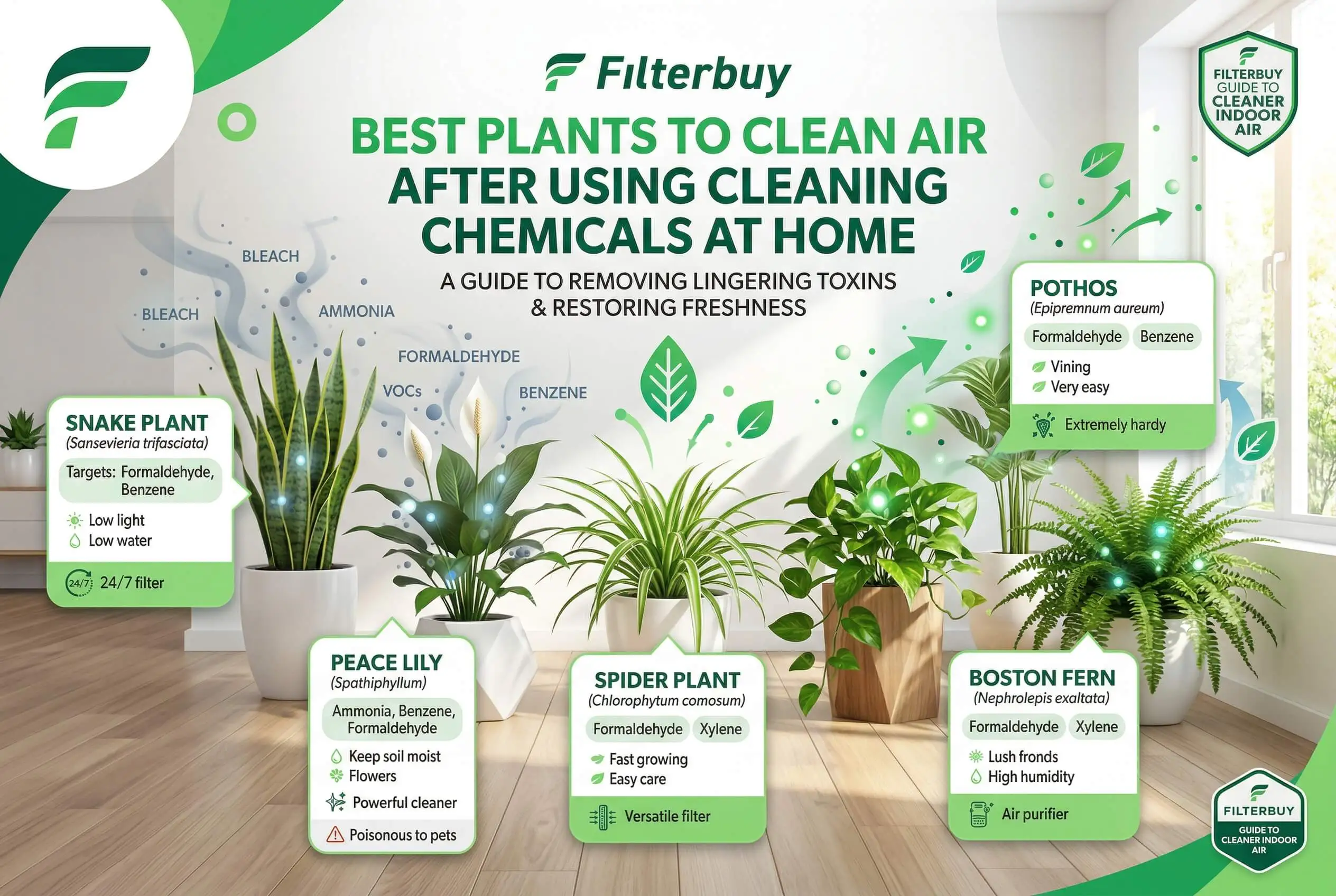
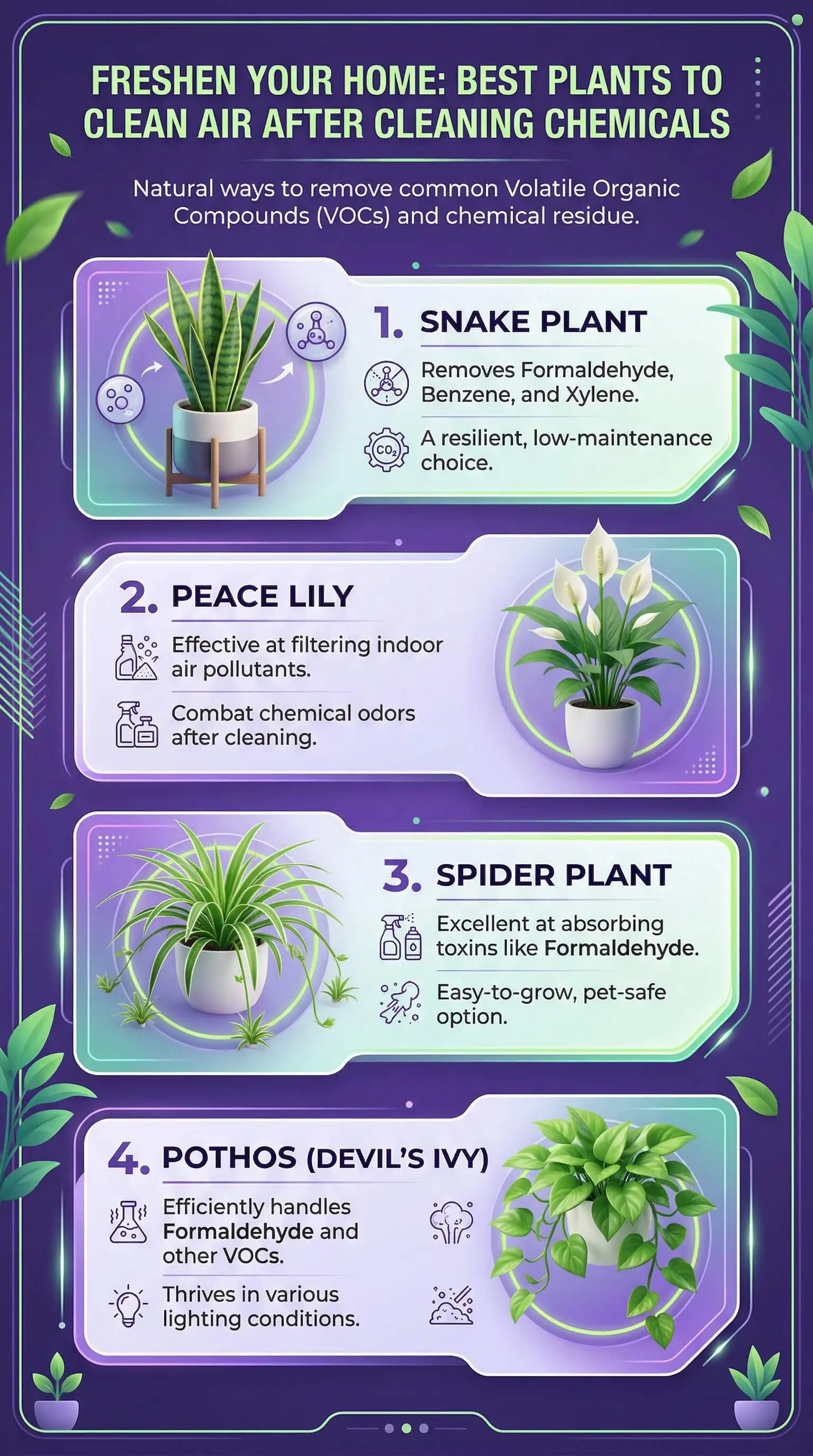
Spider plant — absorbs formaldehyde and xylene; pet-safe; thrives in indirect light
Peace lily — filters ammonia, benzene, and formaldehyde; ideal for bathrooms and low-light spaces
Snake plant — absorbs formaldehyde, benzene, and trichloroethylene; converts CO₂ to oxygen at night
Boston fern — removes formaldehyde and xylene; doubles as a natural humidifier
Rubber plant — effective formaldehyde absorber; large leaf surface area; low maintenance
Golden pothos — filters formaldehyde, benzene, and carbon monoxide; thrives in low light and low humidity
Aloe vera — absorbs formaldehyde and benzene; ideal for sunny windowsills
Where and How Many Plants You Actually Need
Prioritize bathrooms, kitchens, and laundry rooms — highest chemical use, lowest ventilation
Position plants near air vents and return air grilles for maximum contact with circulating air
NASA research recommends one to two plants per 100 square feet in sealed environments
In real homes with HVAC systems, two to three plants per high-use room is a practical starting point
The Most Important Thing We've Learned After Serving Over Two Million Households
Plants alone are not a complete air quality solution — they address gases, not particles
HVAC filters address particles, allergens, mold spores, and fine particulates that plants cannot capture
The homes with the cleanest air combine both — plants for passive VOC absorption, filters for whole-home mechanical filtration
Changing your HVAC filter on schedule is the single highest-impact air quality habit in any home
Why Cleaning Chemicals Pollute Your Indoor Air
Most homeowners assume that a clean-smelling home is a safe-smelling home. In our experience, that assumption is one of the most common indoor air quality mistakes we see.
Common household cleaners — including multi-surface sprays, bathroom disinfectants, floor cleaners, and glass cleaners — release volatile organic compounds (VOCs) during and after use. These include formaldehyde, benzene, ammonia, and trichloroethylene. According to the U.S. Environmental Protection Agency, VOC concentrations indoors can run two to five times higher than outdoor levels, and spike even further during cleaning activity.
The problem doesn't stop when the cleaning does. VOCs continue off-gassing into your air for hours, settling into soft surfaces like curtains, rugs, and upholstered furniture — and recirculating through your HVAC system with every cycle.
How Plants Help Remove Chemical Pollutants From Indoor Air
Plants absorb airborne pollutants through a process called phytoremediation. Their leaves, roots, and the microorganisms living in their soil work together to break down VOCs and convert carbon dioxide into oxygen.
A foundational NASA Clean Air Study identified specific plant species capable of filtering benzene, formaldehyde, trichloroethylene, xylene, and ammonia from enclosed indoor environments. While plants work more slowly than mechanical air filtration, they provide a continuous, passive layer of air cleaning that operates around the clock — no filter changes required.
The Best Plants to Clean Air After Using Cleaning Chemicals
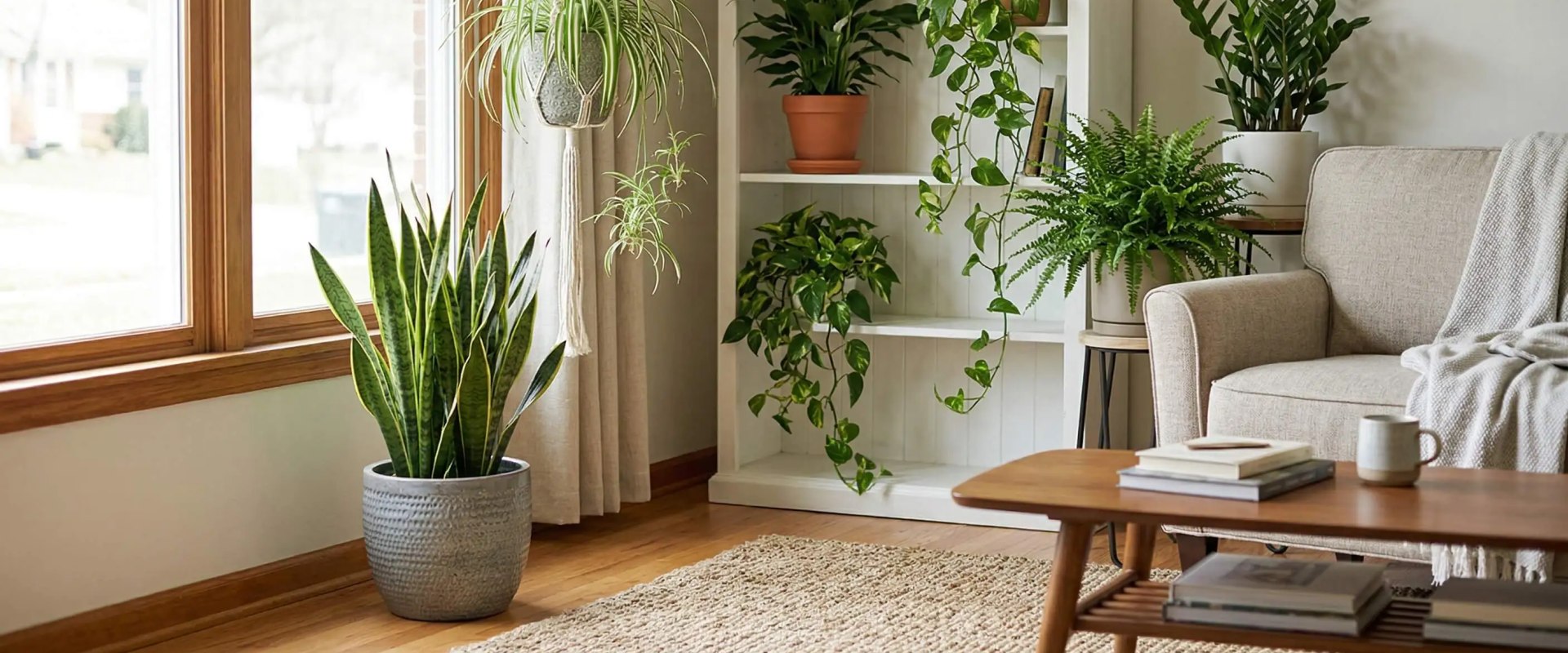
Spider Plant (Chlorophytum comosum)
One of the most effective and forgiving air-purifying plants available. Spider plants are proven absorbers of formaldehyde and xylene — two of the most common VOCs released by household cleaners and air fresheners. They thrive in indirect light, tolerate irregular watering, and propagate easily, making them a practical choice for most rooms.
Peace Lily (Spathiphyllum)
The peace lily is one of the few flowering plants proven to filter ammonia — a compound released heavily by glass cleaners, floor waxes, and bathroom disinfectants. It also absorbs benzene and formaldehyde. Peace lilies perform well in low-light conditions, making them ideal for bathrooms and laundry rooms where cleaning chemicals are used most frequently.
Note: Peace lilies are toxic to cats and dogs. Keep them out of reach of pets.
Snake Plant (Sansevieria trifasciata)
The snake plant is unique because it converts CO₂ into oxygen at night rather than during the day — complementing the daytime air-cleaning cycle of other plants in your home. It absorbs formaldehyde, benzene, trichloroethylene, and xylene, and it requires almost no maintenance. It is one of the most resilient air-purifying plants available for high-use areas like kitchens and bathrooms.
Boston Fern (Nephrolepis exaltata)
Boston ferns are particularly effective at removing formaldehyde and xylene, and they double as natural humidifiers — releasing moisture vapor that helps dilute airborne chemical concentrations. They perform best in humid environments, which makes them well-suited for bathrooms and kitchens where ventilation is limited and cleaning chemicals are used regularly.
Rubber Plant (Ficus elastica)
Rubber plants are effective absorbers of formaldehyde, one of the most persistent VOCs in household cleaning products. Their large, waxy leaves offer significant surface area for absorption. They prefer bright, indirect light and minimal watering — a low-maintenance option for living rooms and open-plan spaces where chemical residue can drift from adjacent rooms.
Golden Pothos (Epipremnum aureum)
Golden pothos is one of the most studied air-purifying plants and one of the hardest to kill. It filters formaldehyde, benzene, and carbon monoxide effectively, and grows well in low-light and low-humidity environments. It is an ideal candidate for hallways, closets, and utility rooms where air circulation is limited and cleaning product residue tends to accumulate.
Aloe Vera
Aloe vera absorbs formaldehyde and benzene — compounds found in many commercial cleaning sprays and polishes. It is a passive, low-maintenance plant that thrives in sunny windowsills. As a practical bonus, it doubles as a first-aid resource for minor skin irritation caused by chemical exposure during cleaning.
Where to Place Air-Purifying Plants for Maximum Effect
Placement matters as much as plant selection. After years of studying how airborne pollutants move through homes, we recommend concentrating air-purifying plants in the rooms where cleaning chemicals are used most heavily and where ventilation is naturally limited.
Prioritize these locations:
Bathrooms: High-concentration disinfectant and bleach use in a small, often windowless space makes bathrooms one of the highest-risk rooms for VOC buildup. Peace lilies and Boston ferns perform especially well here.
Kitchens: Multi-surface sprays, oven cleaners, and degreasing agents release some of the highest VOC concentrations of any room. Snake plants and rubber plants are well-suited to kitchen environments.
Laundry rooms: Detergents, fabric softeners, and stain removers all off-gas into a typically small, enclosed space. Golden pothos and spider plants thrive in these conditions.
Living rooms and bedrooms: Chemical residue migrates from high-use areas into living spaces through HVAC airflow. Positioning plants near air vents and return air grilles increases their contact with circulating air.
How Many Plants Do You Actually Need?
The original NASA research suggested approximately one plant per 100 square feet of living space to achieve meaningful air quality improvement in a sealed environment. Real-world homes — with HVAC systems, open windows, and variable ventilation — require a higher density to produce equivalent results.
In our experience, a practical and realistic starting point is two to three plants per room in high-use areas, combined with regular HVAC filter maintenance to address the pollutants plants cannot capture on their own.
Plants and Air Filtration Work Better Together
Plants are a powerful, natural complement to indoor air quality management — but they are not a complete solution on their own. Phytoremediation works slowly and works best on specific compounds. Mechanical air filtration, by contrast, captures a broader range of airborne particles — including dust, allergens, mold spores, and fine particulates — that plants cannot process.
The most effective approach combines both: plants providing continuous, passive VOC absorption between cleaning sessions, and a quality HVAC filter removing the full spectrum of indoor air contaminants on every air cycle. Together, they address what neither can fully solve alone.
"Most homeowners think cleaning day improves their indoor air quality — and in one sense, it does. But after manufacturing air filters for over a decade and serving more than two million households, we've seen the data that tells a different story. The same cleaning session that removes surface bacteria and visible grime can spike your indoor VOC levels for hours afterward. What you can't see is often what matters most. Plants help — but they work best as part of a layered approach. The homes with the cleanest air aren't relying on any single solution. They're combining natural absorption with mechanical filtration, and they're changing their HVAC filters on schedule. That combination is what actually moves the needle on indoor air quality — especially on cleaning day."
Essential Resources
After manufacturing air filters for over a decade and helping more than two million households breathe cleaner air, we know that the best decisions about indoor air quality come from the best sources. The resources below are the ones we return to ourselves — government research, peer-reviewed science, and honest health authority guidance that gives you the full picture, not just the popular one.
1. The Original NASA Research That Started the Conversation on Air-Purifying Plants
This is the foundational 1989 NASA study that identified specific houseplants capable of filtering benzene, formaldehyde, and trichloroethylene from sealed indoor environments. Every air-purifying plant recommendation you've ever read traces back here — so it's worth reading the source yourself.
https://ntrs.nasa.gov/citations/19930072988
2. What the EPA Wants You to Know About VOCs in Your Cleaning Products
We've seen what cleaning chemicals do to indoor air quality — and this EPA resource puts the data behind it. VOC concentrations indoors can run two to five times higher than outdoor levels, and spike further during and after cleaning. This page explains which compounds are most common, where they come from, and why they linger long after the mop goes away.
https://www.epa.gov/indoor-air-quality-iaq/volatile-organic-compounds-impact-indoor-air-quality
3. The EPA's Practical Guide to Air Cleaners, HVAC Filters, and What Actually Removes VOCs
Plants are one layer of defense — but not all air cleaning methods address the same pollutants. This EPA guide breaks down how HVAC filters, portable air cleaners, and other filtration options compare for removing the chemical residue that household cleaning products leave behind. It's the resource we point customers to when they want to understand the full filtration picture.
https://www.epa.gov/indoor-air-quality-iaq/guide-air-cleaners-home
4. The EPA's Three-Strategy Framework Every Homeowner Should Understand
Source control, ventilation, and filtration — these are the three evidence-based pillars of indoor air quality management, according to the EPA. Understanding this framework is what separates homeowners who get results from those who rely on a single solution. This is where plants and HVAC filters both find their proper place in a layered approach.
https://www.epa.gov/indoor-air-quality-iaq/improving-indoor-air-quality
5. What the American Lung Association Says About the Real Limits of Houseplants
We respect honesty in air quality guidance — which is why we include this one. The American Lung Association provides a balanced, evidence-based assessment of what plants can and cannot realistically accomplish inside a ventilated home. The nuance here matters: plants work, but understanding their limitations is what helps you deploy them effectively alongside proper filtration.
https://www.lung.org/blog/houseplants-dont-clean-air
6. What CDC Research Reveals About Cleaning Chemicals and Airborne Health Risks
This NIOSH resource gets into the chemistry most homeowners never see coming. Common cleaning product ingredients — including pine oil and standard disinfectants — react with indoor ozone to generate entirely new airborne compounds that can trigger respiratory irritation and airway symptoms. Making the invisible visible is something we believe in deeply, and this research does exactly that.
https://www.cdc.gov/niosh/bulletin/2009/indoor-air.html
7. The Peer-Reviewed Study That Documents What Cleaning Products Are Actually Doing to Your Air
Published on the National Institutes of Health platform, this study synthesizes decades of research confirming that routine cleaning and disinfecting raises occupant exposure to harmful chemical air contaminants and fine particulate matter. It also identifies the best practices that reduce that exposure — practical guidance grounded in real science, not marketing claims.
https://pubmed.ncbi.nlm.nih.gov/38917624/
These resources clarify that air-purifying plants are just one layer in a proven indoor air strategy, and pairing source control, ventilation, and HVAC filtration with air purifiers is often what delivers the most reliable protection against VOCs and cleaning-chemical byproducts.
Supporting Statistics
After manufacturing air filters for over a decade and serving more than two million households, we know data alone doesn't change behavior. Context does. Here is what the research says — and what it actually means inside your home on cleaning day.
The Home You Clean Most Is the Home You Breathe Most
Most homeowners focus on outdoor air pollution. In our experience, that's the wrong place to focus.
Americans spend approximately 90% of their time indoors, where pollutant concentrations are often 2 to 5 times higher than outdoor levels. US EPA
What this means at home:
Cleaning sprays, disinfectants, and surface cleaners release VOCs during and after use
Those VOCs recirculate through your HVAC system with every air cycle
Post-cleaning VOC load peaks in the rooms you clean most — bathrooms, kitchens, laundry rooms
Plants and proper filtration are specifically designed to address what lingers after the cleaning is done
The home you clean most is often the home with the highest post-cleaning VOC load. That's the invisible side of a clean house most homeowners never see.
Source: U.S. Environmental Protection Agency — Indoor Air Quality https://www.epa.gov/report-environment/indoor-air-quality
The Symptoms That Show Up After Cleaning Day Are Not a Coincidence
The headache, the scratchy throat, the sudden fatigue after scrubbing the bathroom or mopping the floors — that's not tiredness. That's chemistry.
Key findings from peer-reviewed research:
Over one third of Americans report adverse health effects — including respiratory difficulties and migraine headaches — from exposure to fragranced products. PubMed Central
Of those individuals, half reported the effects can be disabling. PubMed Central
19.7% of the U.S. population reported health problems specifically from being in a room after it was cleaned with scented products. PubMed Central
After helping millions of households improve their indoor air, we've found this is one of the most under-recognized sources of daily respiratory discomfort in American homes. People blame allergies. They blame the season. They rarely blame the cleaner they used four hours ago — but the research points directly there.
Source: National Institutes of Health — Fragranced Consumer Products: Exposures and Effects From Emissions https://pmc.ncbi.nlm.nih.gov/articles/PMC5093181/
For 25 Million Americans With Asthma, Cleaning Day Is a Health Event
One pattern we see consistently across the households we serve: the families most affected by indoor air quality issues are often the ones cleaning most diligently.
The numbers behind that pattern:
About 25 million Americans — 7.7% of the U.S. population — had asthma in 2021, up from 20.3 million in 2001. CDC
Workers regularly exposed to cleaning and disinfection products have a twofold increased likelihood of new-onset asthma. CDC
For the 25 million Americans already managing asthma — and the families who live with them — cleaning day is a recurring air quality challenge, not a neutral household task
The most practical response:
Place air-purifying plants in the rooms where cleaning chemicals are used most heavily
Maintain a quality HVAC filter on schedule to capture what plants cannot
Treat post-cleaning air recovery as a standard part of your cleaning routine — not an afterthought
Source: CDC — Asthma Surveillance in the United States, 2001–2021 https://www.cdc.gov/asthma/asthma-prevalence-us-2023-508.pdf
Final Thoughts
Cleaning your home is one of the most protective things you can do for your family. But without the right air quality strategy in place, it can also be one of the most polluting.
Here is what we know after more than a decade of manufacturing air filters and helping over two million households breathe cleaner air:
Cleaning chemicals release VOCs that linger for hours after the cleaning is done
Those VOCs recirculate through your HVAC system and settle into soft surfaces throughout your home
The right houseplants provide continuous, passive absorption between cleaning sessions
Plants and filtration solve different parts of the same problem — neither is complete without the other
The best air-purifying plants for post-cleaning recovery are not complicated to find or difficult to maintain. Spider plants, peace lilies, snake plants, Boston ferns, rubber plants, golden pothos, and aloe vera are all proven performers that work quietly in the background — absorbing formaldehyde, benzene, ammonia, and other VOC compounds released by the products most commonly used on cleaning day.
What makes the difference between a home with good air and a home with great air comes down to three habits:
Place two to three air-purifying plants in the rooms where cleaning chemicals are used most heavily
Keep plant leaves clean and soil healthy so phytoremediation stays active
Change your HVAC filter on schedule so mechanical filtration captures what plants cannot
No single solution protects your family's air completely. But the homeowners we hear from most — the ones who notice real, lasting improvement in how their home feels and how their family breathes — are the ones who treat indoor air quality as a layered system, not a one-time fix.
Plants are a powerful first layer. A quality air filter is the one that works around the clock on everything else.
FAQ on Air Purifying Plants
Q: Do air purifying plants actually work, or is this just a popular myth?
A: They work — but not the way most articles describe.
After helping more than two million households improve their indoor air, we've found plants are best understood as one layer of a complete air quality system — not a standalone fix.
What the science supports:
Plants absorb specific VOCs through leaves, roots, and soil microorganisms
VOCs targeted include formaldehyde, benzene, ammonia, and trichloroethylene
NASA's 1989 Clean Air Study confirmed measurable VOC reduction in sealed environments
In real homes with active HVAC systems, plants need higher density to match lab results
Natural building ventilation can outpace what a small number of plants process alone
The honest answer: plants contribute meaningfully — especially after cleaning — but only as part of a layered system that includes mechanical filtration.
Q: Which plants best remove VOCs from household cleaning chemicals?
A: Most plant guides list the same general recommendations without connecting specific plants to specific cleaning chemicals. Based on NASA research and real-world air quality experience, here are the seven best performers for post-cleaning VOC recovery:
Peace lily — best for ammonia from glass cleaners and disinfectants
Spider plant — targets formaldehyde and xylene; pet-safe
Snake plant — filters formaldehyde, benzene, and trichloroethylene; works overnight
Boston fern — removes formaldehyde and xylene; adds humidity to dilute airborne chemicals
Golden pothos — filters formaldehyde, benzene, and carbon monoxide; thrives in low light
Rubber plant — high-surface-area formaldehyde absorber for open living spaces
Aloe vera — targets formaldehyde and benzene from cleaning sprays
For homes where ammonia-heavy products are used regularly, the peace lily is the most targeted performer.
Q: How many air purifying plants do I need to make a real difference?
A: More than most guides suggest — and placement matters as much as quantity.
NASA's original recommendation of one to two plants per 100 square feet was based on sealed lab conditions. Real homes need a higher density.
What we recommend based on real-world experience:
Two to three plants per room in high-use areas
Priority rooms: bathrooms, kitchens, laundry rooms
Position plants near air vents and return grilles for maximum airflow contact
Keep leaf surfaces dust-free — buildup blocks the stomata that absorb VOCs
Pair plants with a quality HVAC filter to cover the full pollutant spectrum
One plant in the corner of a large room produces minimal measurable impact. The right plants, in the right rooms, at the right density — that is what moves the needle.
Q: Are air purifying plants safe for homes with pets and children?
A: Not all of them — and this is the check most homeowners skip until it's too late.
Toxic to pets and children if ingested:
Peace lily
Snake plant
Golden pothos
Rubber plant
English ivy
Safe for homes with pets and children:
Spider plant
Boston fern
Areca palm
For households with pets or young children, the spider plant is the safest high-performing option. It absorbs formaldehyde and carbon monoxide effectively, tolerates irregular watering, and carries no toxicity risk.
Always verify safety using the ASPCA Toxic and Non-Toxic Plant database before any new plant enters your home.
Q: Can air purifying plants replace an HVAC filter?
A: No — and this is the most important distinction in any home air quality strategy.
Plants and HVAC filters solve fundamentally different problems:
Plants absorb specific gaseous VOCs through phytoremediation — slowly and passively over hours
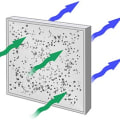
HVAC filters capture particulate matter — dust, allergens, mold spores, pet dander, and fine particles — on every air cycle
A home with plants but no functioning HVAC filter remains fully exposed to particulates and VOCs that exceed the plants' absorption capacity
Across more than two million households, the pattern is consistent:
Plants handle gases passively between cleaning sessions
A quality HVAC filter — changed on schedule — captures everything else
Together they address what neither can solve alone
The homes with the cleanest air don't choose between plants and filtration. They use both.
Ready to Protect Your Home's Air Beyond the Best Plants to Clean Air After Using Cleaning Chemicals?
The right plants are a powerful first step — but a quality HVAC filter is what captures the full spectrum of airborne contaminants that plants alone cannot reach. Find the right filter for your home at Filterbuy and complete the layered air quality system your family deserves.