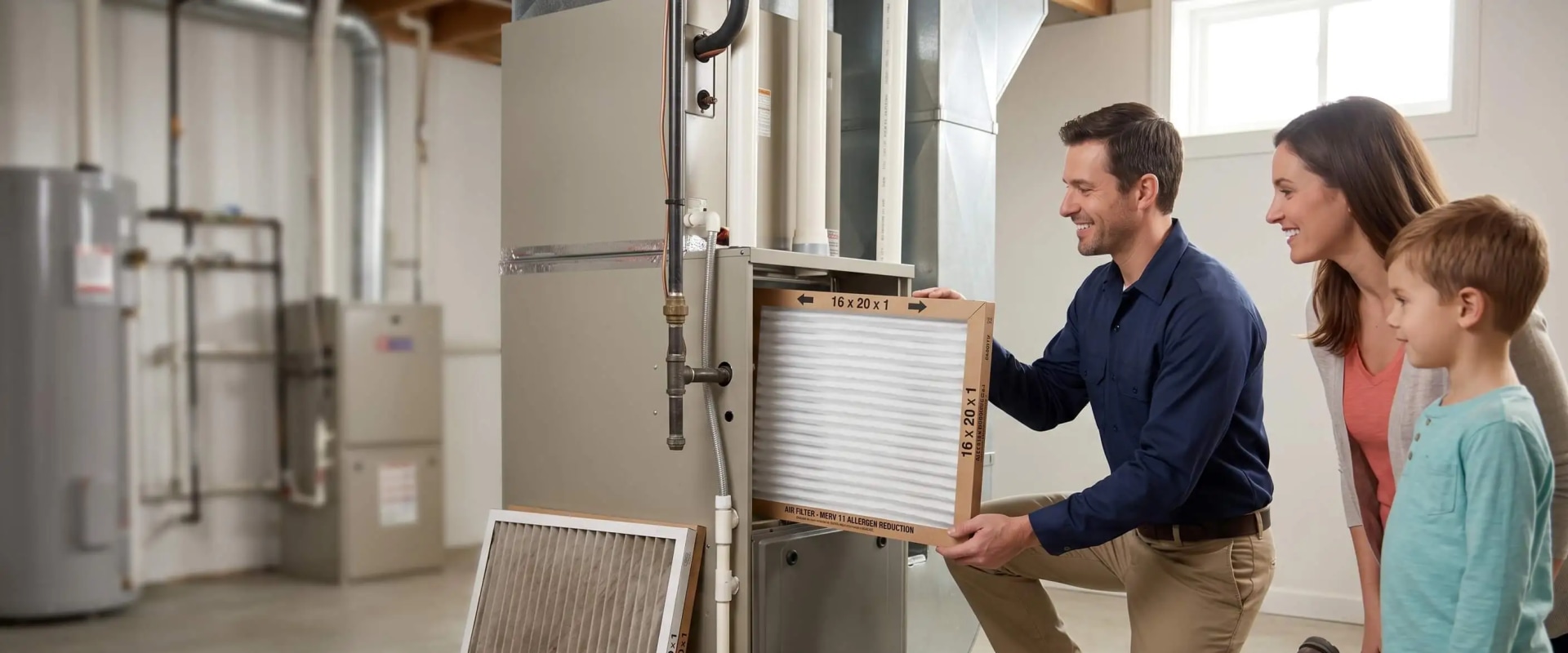
The short answer is yes: changing your 16x20x1 more often genuinely improves indoor air quality. How much more often depends on four variables specific to your household. By the time you finish reading, you’ll know which ones apply to yours and what to do about them.
TL;DR Quick Answers
16x20x1 HVAC home air filter
A 16x20x1 HVAC home air filter is a pleated residential filter measuring 16 by 20 inches wide with a 1-inch depth (nominal sizing). It fits the return air slot of a furnace or air handler and captures airborne particles — dust, pollen, pet dander, mold spores, and fine particulate matter — before they cycle back through your home's air supply.
Key facts every homeowner should know about this size:
Actual dimensions: Typically 15.5 x 19.5 x 0.75 inches. The 16x20x1 designation refers to the slot opening, not the filter itself.
MERV ratings: MERV 8 for standard homes without pets or respiratory conditions. MERV 11 for homes with pets or mild allergy sufferers. MERV 13 for households managing asthma or significant allergen sensitivity.
Change frequency: Every 30 to 90 days depending on household conditions. The 1-inch depth loads faster than thicker sizes — most active households should inspect monthly and plan to replace every 30 to 45 days.
What it protects: Your family's indoor air and your HVAC system. A saturated 16x20x1 increases system static pressure, raises energy costs, and recirculates the particles it already collected rather than trapping them.
Choosing MERV: Higher ratings capture finer particles but load faster. Confirm your system fan can handle the increased static pressure before upgrading beyond MERV 8.
The 16x20x1 HVAC home air filter is one of the most common residential filter sizes in the country and one of the most frequently left in too long. The standard 90-day guidance was built around thicker media. For this depth, a monthly visual inspection is the most reliable replacement signal you have.
Top Takeaways
Changing your 16x20x1 more often genuinely improves indoor air quality. The 1-inch media depth is the reason: this size reaches saturation faster than thicker filters, which makes change frequency more consequential here than it is for most residential sizes.
Filtration performance follows a curve. The peak window typically falls between days 10 and 30. After saturation, fine particulates start bypassing the media instead of getting captured by it.
Your MERV rating changes your replacement schedule. MERV 8 typically holds 60 to 90 days under normal conditions. MERV 11 calls for 30 to 60. MERV 13 in an active household needs a 30-day check-in at minimum.
Pets, occupancy, local air quality, and HVAC runtime are the four variables that push a 16x20x1 from a 90-day situation to a 30-day one. Most active households are closer to the shorter end than they think.
The light test is your most reliable replacement signal: hold the filter to a light source. If light doesn’t pass through, the filter is past due.
A clogged 16x20x1 doesn’t just fail to clean your air. It adds resistance to the system, drives up energy costs, and can recirculate the particles it already collected.
Treat published replacement dates as a ceiling. Inspect monthly. Replace based on what you find, not what the calendar says.
What the 16x20x1 Dimension Actually Tells You — and Why It Matters
Three numbers make up the 16x20x1 designation: width, height, and depth, each expressed in nominal inches. The actual dimensions run slightly smaller (typically 15.5 by 19.5 by 0.75 inches) because nominal sizing refers to the slot opening, not the filter itself. That distinction matters at purchase, but the depth number is where air quality decisions begin.
A 1-inch air filter operates with a fraction of the media surface area available in thicker sizes. A 16x20x4, for comparison, carries roughly four times the media depth and holds proportionally more captured particulate before loading up. The 16x20x1 reaches saturation faster by design. That physical reality should drive your replacement schedule far more than any calendar-based rule developed for thicker media.
Deeper filters also achieve more pleats per panel, giving the media more surface to work with and extending useful service life. A 16x20x1 starts with tighter constraints. When someone tells you 90 days is a reliable standard for this size, they’re working from a formula that wasn’t built around it.
After manufacturing filters for over a decade and serving more than two million households, we’ve found the 1-inch depth is consistently underrepresented in standard replacement advice. Published intervals draw from average usage patterns across mixed filter sizes. A 16x20x1 in an active household almost never matches those averages.
How Filter Change Frequency Directly Affects Indoor Air Quality
Filtration performance isn’t fixed. It follows a curve, and where your 16x20x1 sits on that curve depends entirely on how long it’s been running.
In the early days of service, a fresh filter captures many particles, but high efficiency filters are especially effective at targeting the finest particulates, including the sub-micron particles higher MERV ratings are designed to trap. As the filter collects dust and debris, the media can become even more effective for a short window: accumulated particles create a secondary filtration layer that helps high efficiency filters capture finer particulates than the base media could intercept on its own.
That’s the peak performance window. For a 16x20x1 in a typical residential system, it arrives somewhere between days 10 and 30, depending on household conditions. After that peak, saturation sets in and performance drops sharply. Airflow restriction builds static pressure in the duct system, the HVAC fan works harder to compensate, and fine particles below 2.5 microns (what the EPA classifies as PM2.5) begin bypassing the loaded media rather than getting captured by it.
16x20x1 air filters replaced on a monthly or bi-monthly schedule keep a system operating in or near that peak window. Homeowners who stretch to 90 days or more in an active household run on degraded filtration for the bulk of that period. The air quality difference between those two households is measurable in particulate counts and system performance data.
The Right MERV Rating for a 16x20x1 Filter — and How It Changes the Math
MERV rating controls which particle sizes a filter captures and at what efficiency. It also directly determines how quickly a 16x20x1 loads. Your MERV selection changes your replacement schedule as much as any other factor in this guide.
Three ratings cover most residential use at this size:
MERV 8: Captures dust mites, mold spores, pollen, and coarser particulates. The right choice for standard households without pets or diagnosed respiratory conditions. A MERV 8 in a 16x20x1 slot typically holds useful performance for 60 to 90 days under normal occupancy and air quality conditions.
MERV 11: Adds capture of fine particulate, smoke, and allergen categories that MERV 8 misses. Households with pets or mild allergy sufferers will notice the difference in protection. The trade-off is loading speed. Plan for a 30 to 60-day change cycle rather than 90.
MERV 13: Targets PM2.5 and a broader range of bacterial carriers and fine smoke particles. The right call for households managing asthma or serious allergy conditions. At the 16x20x1 size, MERV 13 media loads significantly faster. A 30-day check-in with replacement as needed is the working standard.
One practical note before upgrading: check with your HVAC technician that your system fan can handle the increased static pressure that comes with higher-efficiency media. A MERV 13 filter in an undersized fan system can restrict airflow enough to offset the air quality gain.
Four Household Variables That Shift the Change Schedule
Published replacement intervals give you a baseline built around average conditions. Most homes don’t run on average. These four variables tell you where your 16x20x1 sits relative to that baseline and whether you should be moving faster.
Pets. Pet dander and shed hair accelerate filter loading faster than almost any other household factor. In a home with two or more pets running a MERV 11 or higher, a 16x20x1 can saturate within 30 days. Monthly inspections here aren’t a precaution. They’re the floor.
Occupancy. A single-person household generates far less airborne particulate than a family of four, all other conditions equal. More people means more skin cell shedding, more tracked-in debris, more cooking output, and more respiratory load on the filter. Larger families should plan for the shorter end of any published range.
Local air quality. Homes near high-traffic roads, active construction, agricultural operations, or in regions with extended pollen seasons load filters more aggressively than homes in cleaner suburban areas. Outdoor AQI data, accessible through AirNow, gives you a concrete signal for when conditions should push you toward an earlier change.
HVAC runtime. This is the variable most homeowners underestimate. A system running 18 to 22 hours a day in a Florida home during peak cooling season cycles dramatically more air through the filter than one running 8 hours a day in a mild climate. More runtime means faster loading. The physics are that direct.
How to Know When Your 16x20x1 Filter Actually Needs to Be Changed
Think of the calendar as a ceiling on how long the filter should stay in — not a signal that everything is fine until that date. Inspecting before the scheduled change gives you real data a schedule can’t provide. Four quick checks take less than two minutes combined.
The light test. Remove the filter and hold it up to a light source. A filter still in its service window allows light through the pleats, even if the surface looks gray with collected dust. When the media is uniformly dark and light no longer passes through, the filter is past due.
The airflow check. Weaker output from your supply registers is a reliable early signal. A saturated 16x20x1 builds static pressure in the duct system. Your registers respond with noticeably reduced airflow. If you catch that shift, pull the filter before calling a technician.
The smell test. Musty or stale air circulating through the home often points to biofilm formation on saturated media. Once mold spores or bacteria colonize a loaded filter, it recirculates contaminants rather than removing them. Trust your nose on this one.
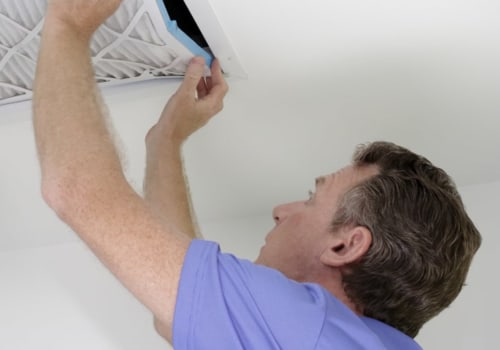
The monthly check-in. Build a visual inspection into your calendar every 30 days, regardless of when replacement is scheduled. Pull the filter, inspect it against a light source, reinstall if it passes, and replace if the media fails. Five minutes. Consistent air quality.
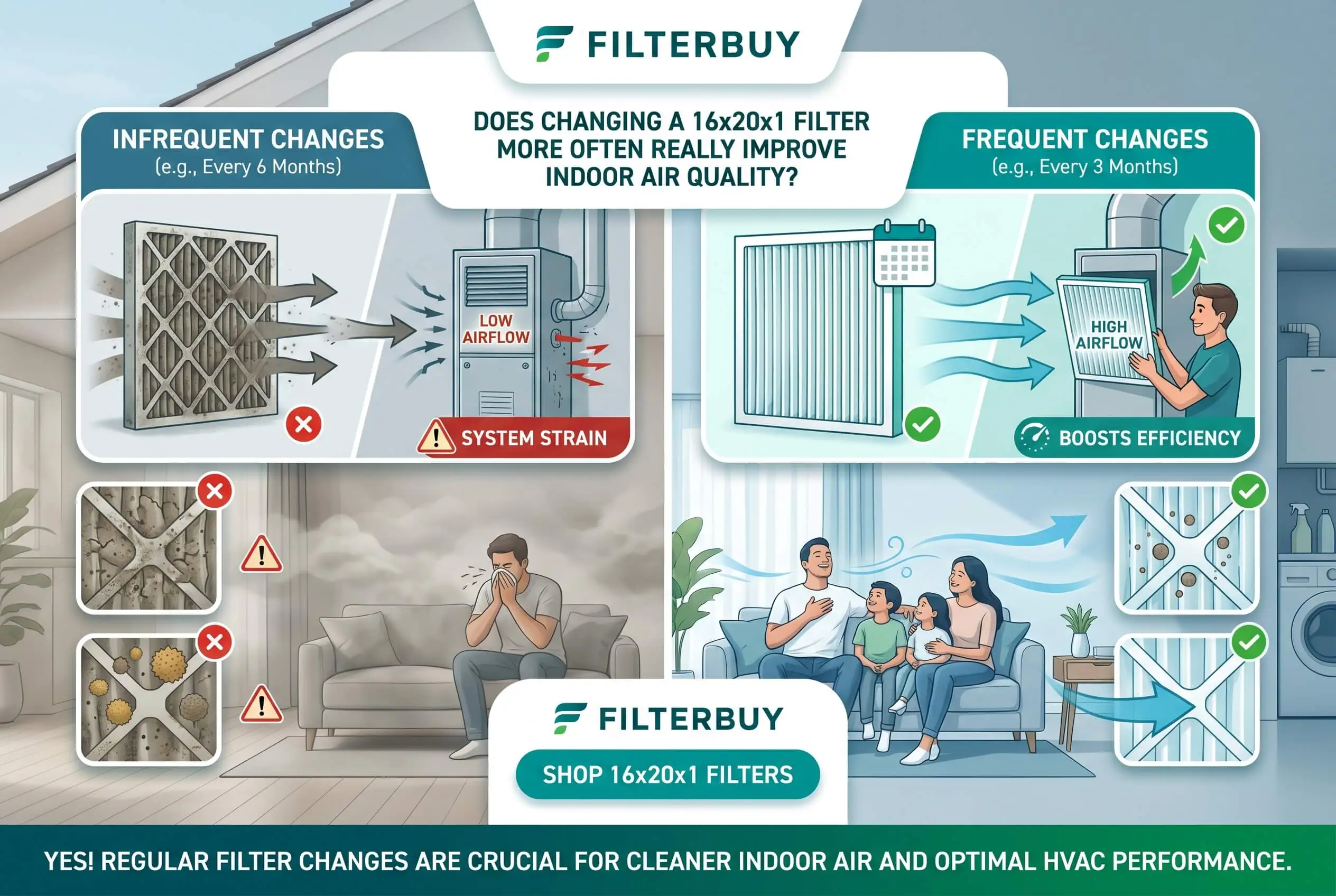
“After manufacturing millions of 16x20x1 filters, we consistently find that the 1-inch depth reaches functional saturation 40 to 60 percent faster in active households than standard industry intervals assume. Our recommendation has always been to treat published replacement dates as a maximum, not a target, and to build a monthly visual inspection into every homeowner’s routine. The households that do this consistently report better system performance and fewer air quality complaints year over year.”
7 Essential Resources
We keep these seven resources bookmarked for homeowners who want to go beyond the basics. Every one comes from a federal agency, research institution, or recognized industry authority, and each addresses a different piece of the indoor air quality picture.
1. The Federal Framework Behind Everything You Know About Indoor Air
The EPA’s Introduction to Indoor Air Quality page covers how indoor pollutants enter a home, accumulate, and affect health over time. It explains the primary pollutant categories: combustion byproducts, biological contaminants, and chemical emissions, alongside the three intervention strategies that filter maintenance fits into: source control, ventilation, and filtration. It’s where the “why behind the filter” lives. Start here.
Source: https://www.epa.gov/indoor-air-quality-iaq/introduction-indoor-air-quality
2. What the CDC Wants You to Know About the Air That Affects Your Health
The CDC’s Air Quality page connects particulate matter exposure directly to health outcomes: which populations carry the greatest respiratory risk, how outdoor pollution translates indoors, and how to use the Air Quality Index as a day-to-day tool. The AQI guidance alone is worth saving. It tells you when outdoor conditions should push your change schedule earlier than the calendar suggests.
Source: https://www.cdc.gov/air-quality/about/index.html
3. Industry Best Practices for Air Filtration From the Nation’s Leading Filter Authority
The National Air Filtration Association publishes best practice guidelines built by certified air filtration specialists, engineers, and facility managers. These go beyond minimum ASHRAE standards and cover residential filtration, HVAC system maintenance, and specific applications including wildfire smoke and allergen-heavy environments. NAFA’s guidelines are written for the industry professionals who specify, install, and maintain filtration systems. Reading them gives homeowners the same grounding.
Source: https://www.nafahq.org/best-practice-guidelines/
4. Understanding the Allergen Triggers Your Filter Works to Intercept Every Day
The Asthma and Allergy Foundation of America’s page on allergic asthma identifies the most common inhaled allergens: dust mites, pet dander, pollen, and mold spores, then explains the immune mechanism behind allergic reactions triggered by poor indoor air. If someone in your household has asthma or allergies, this page makes the link between filter performance and respiratory health impossible to ignore.
Source: https://aafa.org/asthma/asthma-triggers-causes/allergic-asthma/
5. How Filter Maintenance Connects Directly to Your Energy Bill
ENERGY STAR’s heating and cooling efficiency page makes the direct financial case for regular filter maintenance. Nearly half of all home energy use goes to heating and cooling, and a dirty filter forces the system to work harder and costs more to run. If the health argument for regular filter changes hasn’t landed yet, the energy bill argument usually does. This page makes both cases in plain terms.
Source: https://www.energystar.gov/saveathome/heating-cooling
6. The Technical Foundation of Filter Installation and HVAC Airflow Performance
The Department of Energy’s Building Science Education resource on HVAC filter installation explains how filters interact with system airflow, static pressure, and equipment health. It covers filter placement, why higher MERV ratings require attention to fan capacity, and how a clogged filter affects furnace run time and motor wear. Thinking about upgrading your MERV rating? This is the technical grounding that product packaging never includes.
Source: https://bsesc.energy.gov/energy-basics/hvac-proper-installation-filters
7. Reducing Indoor Allergen Exposure Through Practical Home Management
The Asthma and Allergy Network’s guide to controlling asthma and allergy triggers provides a room-by-room protocol for reducing indoor allergen load, covering HVAC filter maintenance as part of a larger strategy that includes humidity control, cleaning routines, and pest management. For households treating filter changes as one piece of a broader air quality plan, this resource ties it all together.
Source: https://asthmaandallergies.org/asthma-allergies/controlling-triggers/
Supporting Statistics
These three data points come from verified .gov and .org sources and place the 16x20x1 filter change question in a broader public health and energy context. Each one is rephrased here to reflect what it means from a manufacturing and homeowner perspective, not just as an abstracted finding.
Indoor air pollutant levels are often 2 to 5 times higher than outdoor concentrations — and Americans spend approximately 90 percent of their time indoors.
That finding reshapes the way you should think about your filter. Outdoor air quality gets the headlines, but the air your HVAC circulates through your home is the air your family actually breathes, which is why HEPA air purifiers have become such a trusted addition for improving indoor air quality. A 16x20x1 that’s hit saturation doesn’t just stop cleaning that air. It actively allows captured particulates back into the airstream. EPA research has documented this indoor-outdoor disparity consistently across rural, suburban, and urban settings alike.
Source: https://www.epa.gov/iaq-schools/why-indoor-air-quality-important-schools
Indoor allergens — including dust mites, pet dander, mold spores, and pollen — are among the most common triggers of asthma attacks and allergic reactions in residential settings.
NIH research on indoor allergens and respiratory health confirms that the particulate categories your HVAC filter works hardest to capture are the same ones most associated with asthma and allergic sensitization. A MERV 11 or MERV 13 in the 16x20x1 slot targets these categories directly. When that filter saturates, those particles recirculate. The households that benefit most from an aggressive change schedule are exactly the ones where letting the filter run too long carries the greatest health cost.
Source: https://www.ncbi.nlm.nih.gov/pmc/articles/PMC7068860/
Nearly half of all energy used in a home goes to heating and cooling — and a dirty air filter forces the system to work harder, increasing energy costs and accelerating equipment wear.
ENERGY STAR’s filter maintenance guidance frames what looks like a health issue as an energy and equipment issue at the same time. A 16x20x1 running past saturation creates measurable resistance in the air handling system, driving up fan motor strain and run time well beyond what a fresh filter requires. From a manufacturing standpoint, we’ve seen this play out clearly: households that keep up with consistent changes report fewer HVAC service calls and longer equipment life cycles. Every filter change is maintenance that pays for itself.
Source: https://www.energystar.gov/products/ask-the-experts/how-keep-your-hvac-system-working-efficiently
Final Thoughts and Opinion
The 90-day replacement standard wasn’t built around a 16x20x1. It came from a formula based on average conditions and mixed filter depths, and the 1-inch media has been absorbing the gap ever since. Homeowners who treat that interval as a maximum and inspect monthly will see measurable air quality results. Those who run to the full 90 days in an active household spend most of that cycle on a declining filter without knowing it.
Here’s the opinion worth stating plainly: the variable that matters most isn’t which filter you buy. It’s how often you pull it out, hold it up to the light, and make the call. We’ve worked with homeowners running high-end MERV 13 filters changed every 45 days and homeowners running MERV 8 filters changed every 25. The consistent ones win on air quality, every time.
A calendar tells you when to check, one of the simplest ways to get rid of dust mites. What you find when you check tells you what to do. That’s the whole system. It costs five minutes a month.
Frequently Asked Questions
Q: How often should I change a 16x20x1 air filter?
A: The range for a 16x20x1 runs from 30 to 90 days, but that spread conceals more than it reveals. The variables that push you toward the shorter end include:
Higher MERV rating (MERV 11 or MERV 13 loads faster than MERV 8)
One or more pets in the household
Larger occupancy (families vs. single-occupant homes)
Poor local outdoor air quality or active pollen season
High daily HVAC runtime (common in warm climates)
Most active households with pets or allergy sufferers should inspect their 16x20x1 monthly and expect to replace it every 30 to 45 days. The 90-day standard applies to a single-occupant home with no pets, low HVAC runtime, and a MERV 8 filter.
Q: Does changing a 16x20x1 filter more often actually improve indoor air quality?
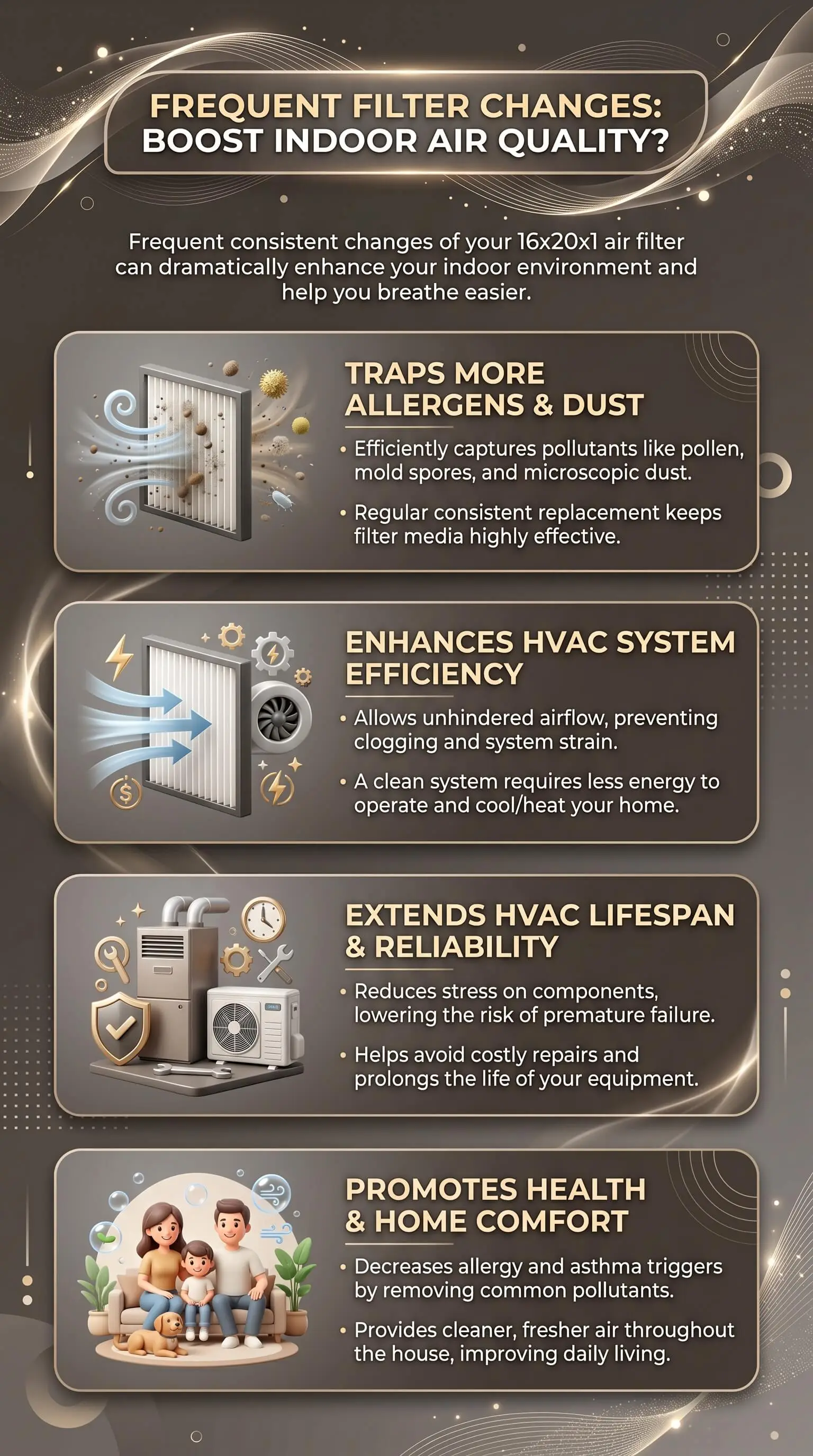
A: Yes, in a direct and measurable way. A fresh or partially loaded 16x20x1 operates near peak efficiency, capturing the particulate it was rated to intercept. When that same filter saturates, fine particulates including PM2.5 bypasses the media and recirculates through the home. More frequent changes keep the filter in its performance window, rather than letting it become a recirculation point for the particles it was meant to stop.
Q: What MERV rating is best for a 16x20x1 filter?
A: MERV 8 for standard homes without respiratory conditions or pets. MERV 11 for homes with pets or mild allergy sufferers. MERV 13 for households managing asthma or significant allergen sensitivity. Before upgrading to MERV 13, check with your HVAC technician that your system fan can handle the increased static pressure. A high-efficiency filter in an undersized system creates its own airflow problems.
Q: Can I clean and reuse a 16x20x1 air filter?
A: No. Standard pleated 16x20x1 filters are single-use disposable products. Washing damages the electrostatic charge built into the media and physically disrupts the fiber structure that enables particle capture. A washed filter may look clean but performs substantially worse than its original rating, and can introduce moisture into your HVAC system if not completely dry before reinstallation.
Q: How do I know when my 16x20x1 filter needs to be changed?
A: Four indicators are reliable:
Light test: hold the filter to a light source. If light doesn’t pass through the media, it’s past due.
Airflow: noticeably weaker output from your supply registers points to increased static pressure in the duct system.
Odor: musty or stale air circulating through the home is often a sign of biological growth on saturated media.
Monthly check-in: set a 30-day inspection reminder regardless of when you last changed the filter.
Q: Does a 16x20x1 filter fit all HVAC systems?
A: No. The 16x20x1 is a common residential size but must match the specific slot dimensions of your system. Always measure the actual filter slot opening before ordering. Nominal sizing (16x20x1) refers to the slot, not the filter, and the actual filter dimensions will be slightly smaller. Systems with non-standard slot configurations require custom sizing.
Q: Is the 16x20x1 designation the actual filter size or a nominal size?
A: Nominal size. The actual physical dimensions of a 16x20x1 filter are typically 15.5 by 19.5 by 0.75 inches, slightly smaller than the designation suggests. The nominal size describes the slot the filter occupies, not the filter itself. When ordering, verify that the actual dimensions match your slot opening, not just the nominal label on the packaging.
Ready to Protect Your Home’s Air Quality?
The 16x20x1 is the most common residential filter size in American homes, and one of the most frequently left in too long. The 90-day guidance most homeowners follow was written for thicker media and average conditions. You know better now.
Filterbuy’s 16x20x1 air filters are manufactured to exact dimensional tolerances, available across MERV 8, MERV 11, and MERV 13, and ship directly to your door so you’re never running on a saturated filter while waiting for an order to arrive. Because the air your family breathes at home shouldn’t be an afterthought.
Better Air For All.