After manufacturing filters for over a decade and serving more than two million households, we've learned something most filter brands won't tell you: the filter rating matters far more than the brand name on the packaging. Pet dander is microscopic — small enough to pass straight through low-rated filters and recirculate through your HVAC system all day long. In our experience, homes with pets need at minimum a MERV 11 filter to make a measurable difference in airborne dander levels.
This page breaks down exactly how air filter home solutions trap pet dander, which MERV ratings actually perform, and what pet owners consistently get wrong when choosing a filter.
TL;DR Quick Answers
air filter home
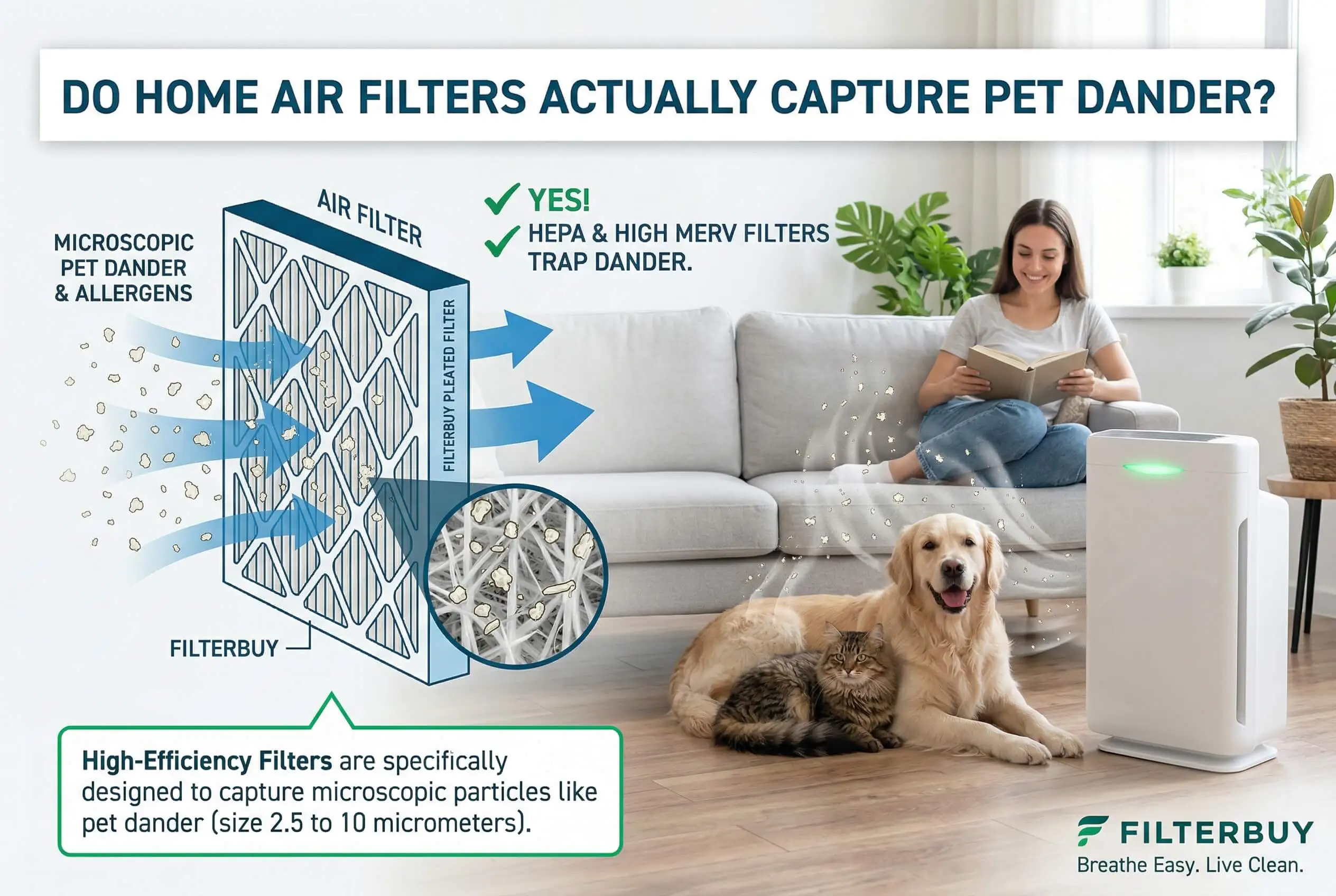
A home air filter captures airborne particles — including pet dander, dust, mold spores, and bacteria — by forcing air through a dense fiber mesh inside your HVAC system. The filter's MERV rating determines what it can and cannot catch. For pet-owning households, MERV 11 is the minimum effective rating. MERV 13 is the strongest option most residential systems can accommodate. After manufacturing filters for over a decade and serving more than two million households, the most important thing we can tell any homeowner is this:
The right MERV rating determines whether your filter captures pet dander or recirculates it.
Replace every 30 to 45 days in pet-occupied homes — not every 90.
A clogged MERV 13 performs worse than a fresh MERV 8.
Pair a MERV 13 HVAC filter with a portable HEPA purifier for the most comprehensive defense against airborne pet dander available in a residential setting.
The filter inside your HVAC system is the single most impactful air quality decision a homeowner makes. Most pet owners are making it without knowing what MERV means. Now you do.
Top Takeaways
MERV rating is the only filter specification that matters for pet owners. Price and brand name tell you nothing about dander capture. Here is what we recommend:
MERV 11 — minimum for homes with one or two pets.
MERV 13 — homes with multiple pets or a family member with diagnosed allergies or asthma.
Your HVAC system is your home's most powerful air-cleaning tool — but only if the filter is rated for the job. Most pet-owning households are running standard residential filters. Those filters were not designed for the dander output of an active pet environment. That mismatch is where indoor air quality problems begin.
Pet dander doesn't behave like visible household dirt. It is microscopic, buoyant, and persistent. Vacuuming and grooming help. They do not replace filtration. Every time your HVAC runs, dander recirculates through every room in the house — caught or uncaught, depending entirely on the filter inside the system.
Replacement frequency matters as much as MERV rating. In pet-occupied homes, filters clog faster than standard timelines assume. Remember:
A clogged MERV 13 performs worse than a fresh MERV 8.
Replace every 30 to 45 days with pets present — not every 90.
For severe pet allergies, one filtration layer is rarely enough. A MERV 13 HVAC filter combined with a portable HEPA purifier in high-traffic pet areas is the most comprehensive defense available. It addresses airborne dander throughout the home — including when the HVAC system isn't actively running.
How Air Filters Trap Pet Dander
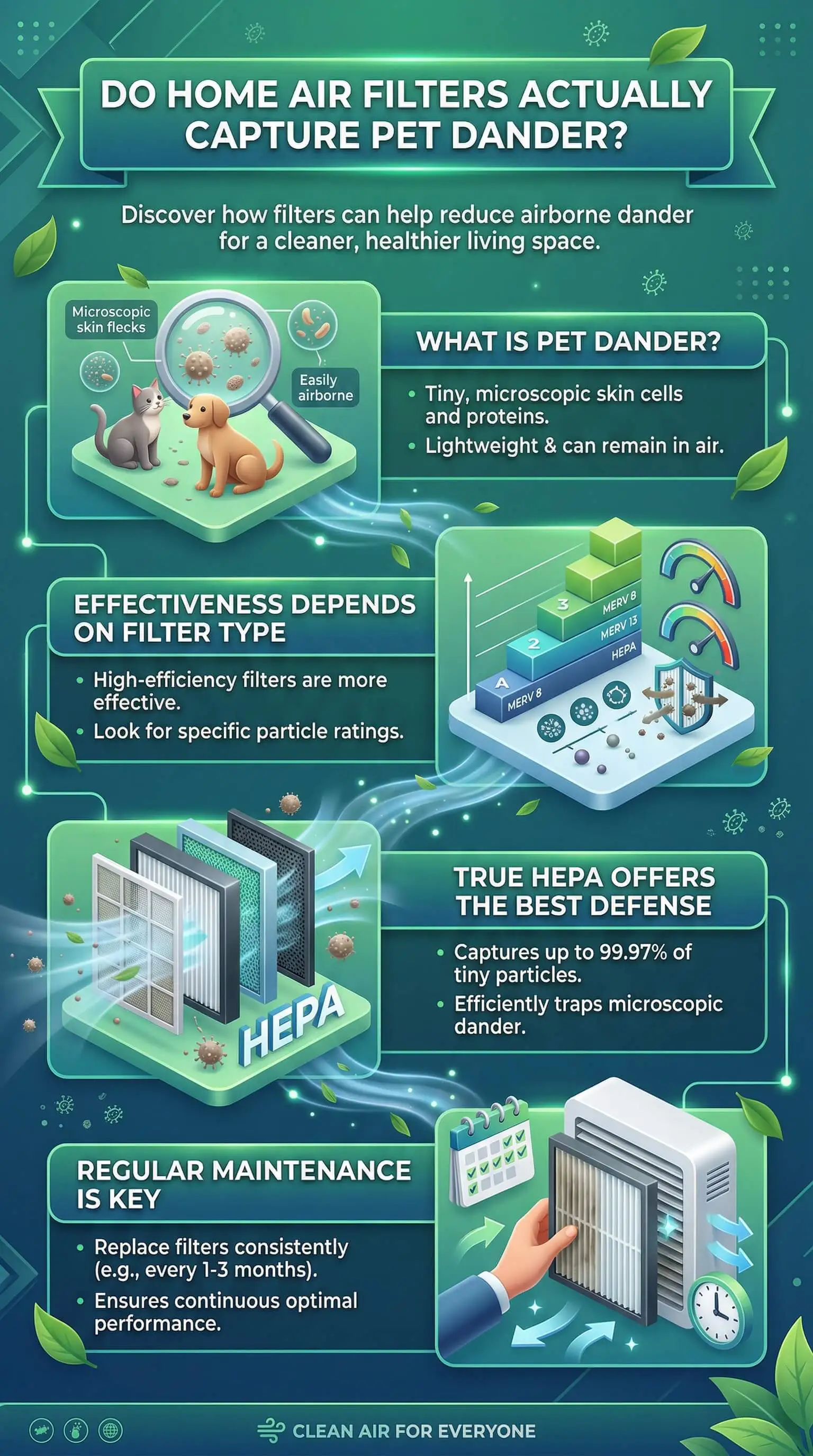
Air filters capture pet dander the same way they capture other airborne particles — by forcing air through a dense web of fibers that intercept, trap, and hold particles as they pass through. The denser the fiber arrangement and the higher the filter's MERV rating, the smaller the particles it can catch. Pet dander typically ranges from 0.5 to 100 microns in size. Lower-rated filters miss the smallest particles entirely. Higher-rated filters are engineered specifically to capture particles in that range before they recirculate back into your living space.
Your HVAC system is actually your home's most powerful air-cleaning tool — but only if the filter inside it is rated for the job.
Why MERV Rating Is the Most Important Factor for Pet Owners
Not all filters are built to handle pet dander, and MERV rating is the clearest indicator of whether yours is up to the task.
MERV 8: Captures larger particles like dust and lint but allows fine pet dander to pass through. Common in standard residential filters and adequate for homes without pets or allergy concerns.
MERV 11: The minimum we recommend for pet owners. Captures fine particles including most pet dander, mold spores, and fine dust. Noticeably improves air quality for households with one or two pets.
MERV 13: The strongest option for most residential HVAC systems. Captures ultrafine particles including pet dander, bacteria, and smoke. Recommended for homes with multiple pets or residents who suffer from pet allergies.
One important note: higher MERV ratings create more airflow resistance. Before upgrading to MERV 13, confirm your HVAC system can handle the increased static pressure. In our experience, most modern residential systems handle MERV 11 and MERV 13 without issue — but older systems may benefit from a professional check first.
What Pet Owners Consistently Get Wrong
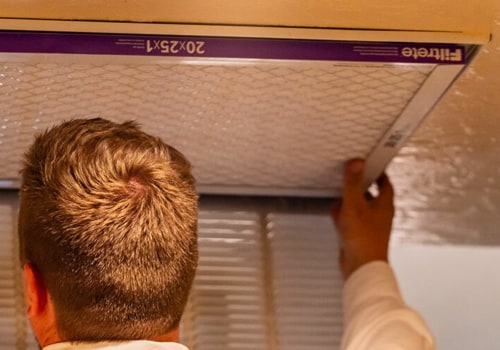
The most common mistake we see among pet-owning households is under-replacing their filters. Pet hair and dander clog filters significantly faster than in pet-free homes. A filter that might last 90 days in a standard household can become restricted and ineffective in as little as 30 to 45 days when pets are present.
A clogged filter does two things that work against you. First, it stops capturing new particles effectively. Second, it forces your HVAC system to work harder, which drives up energy costs and accelerates system wear. Replacing your filter on a consistent schedule — not just when you remember — is one of the simplest, highest-impact things a pet owner can do for their home's air quality.
Do Air Purifiers Help in Addition to HVAC Filters?
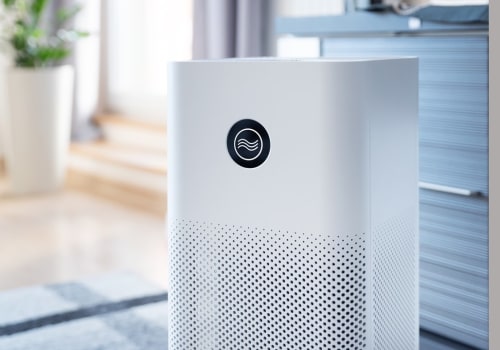
Yes, and for homes with severe pet allergies, layering an air purifier with a high-MERV HVAC filter is a strategy we frequently recommend. Portable HEPA air purifiers capture particles down to 0.3 microns and work independently of your HVAC system, meaning they clean the air in specific rooms even when your heating or cooling isn't running. Used together, a MERV 13 HVAC filter and a HEPA air purifier in high-traffic pet areas create a comprehensive defense against airborne dander throughout your home.
"Most pet owners we talk to are surprised to learn that their HVAC filter is the first line of defense against airborne dander — not a vacuum, not a lint roller, and not an air freshener. After manufacturing filters for over a decade and working with more than two million households, we've seen the same pattern repeat itself: pet owners buying filters based on price or brand familiarity, not MERV rating. That one decision is usually the difference between a home that feels clean and one that doesn't. Pet dander is too small to see and too persistent to ignore. The right filter doesn't just catch it — it keeps it out of the air your family breathes every single day."
Essential Resources
Don't take your indoor air for granted — especially when pets are part of your household. After manufacturing filters for over a decade and serving more than two million households, we know that most pet owners are making filter decisions without the information they need to protect their families. These seven government and nonprofit resources are the ones we point to most often. Read them, and you'll know more about home air filtration than most people ever will.
The EPA's Complete Guide to Air Cleaners for Your Home We recommend this resource first because it strips away the marketing noise and tells you exactly how residential air cleaners and HVAC filters work — straight from the source. If you're starting from zero, start here. https://www.epa.gov/indoor-air-quality-iaq/guide-air-cleaners-home
What MERV Ratings Actually Mean — Straight from the EPA After years of working with customers who chose filters based on price alone, we can tell you that understanding your filter's MERV rating is the single most important step you can take. The EPA explains it clearly, and once you know it, you'll never shop for a filter the same way again. https://www.epa.gov/indoor-air-quality-iaq/what-merv-rating
HEPA Filters Explained: When Your HVAC Filter Isn't Enough In our experience, pet owners with severe allergy symptoms are often running a single HVAC filter and wondering why they're still suffering. This EPA resource explains what HEPA filtration actually is and when layering a portable HEPA air purifier alongside your HVAC filter makes the difference your household needs. https://www.epa.gov/indoor-air-quality-iaq/what-hepa-filter
The Complete Indoor Air Quality Guide Every Homeowner Should Read Clean air isn't just about the filter in your HVAC system — it's about understanding everything that affects the air inside your home. This comprehensive EPA guide makes the invisible visible, covering pollutants most homeowners never think about and giving you a whole-home strategy for protecting your family. https://www.epa.gov/indoor-air-quality-iaq/inside-story-guide-indoor-air-quality
The Science Behind Pet Dander: What the NIH Wants You to Know Most people think pet allergies are about fur. They're not — and the National Institute of Environmental Health Sciences explains exactly why. Understanding what pet dander actually is at a biological level is what separates homeowners who solve the problem from those who keep buying the wrong filter. https://www.niehs.nih.gov/health/topics/agents/allergens/pets
How to Control Indoor Allergens — Guidance from America's Leading Allergy Authority The Asthma and Allergy Foundation of America offers something we value deeply: practical, actionable guidance grounded in real health outcomes rather than product promotion. This resource is especially important if anyone in your household has diagnosed allergies or asthma, and it pairs directly with the filtration decisions you'll make after reading it. https://aafa.org/allergies/prevent-allergies/control-indoor-allergens/
Why Upgrading Your Filter Is the Simplest Thing You Can Do for Cleaner Air This AirNow fact sheet from the EPA makes the case we've been making for over a decade: the difference between a basic fiberglass filter and a properly rated MERV alternative is not marginal — it's measurable. If you need one resource to share with a skeptical spouse or family member, this is it. https://www.airnow.gov/sites/default/files/2021-12/indoor-air-filtration_0.pdf
Supporting Statistics
After manufacturing air filters for over a decade and working with more than two million households, we've seen the same pattern repeat itself: pet owners underestimate what's in their air and overestimate what their current filter is doing about it. These statistics back that up.
6 out of 10 Americans are exposed to cat or dog dander in their homes.
The Asthma and Allergy Foundation of America confirms that six out of ten U.S. residents are currently exposed to cat or dog dander. What surprises most pet owners we work with isn't the number. It's this:
Exposure doesn't require a visible allergic reaction to cause harm.
Dander circulates through HVAC systems daily — whether families feel it or not.
The filter is either catching it or recirculating it. There is no middle ground.
Source: Asthma and Allergy Foundation of America — Control Indoor Allergens to Improve Indoor Air Quality https://aafa.org/allergies/prevent-allergies/control-indoor-allergens/
Indoor pollutant concentrations are often 2 to 5 times higher indoors than outside — and the EPA names pet dander as a direct contributor.
The U.S. Environmental Protection Agency documents that Americans spend approximately 90% of their time indoors, where pollutant concentrations run 2 to 5 times higher than outdoor levels. The EPA specifically identifies pet dander as a biological indoor air pollutant driving that gap. We've seen this play out in real households:
Families who vacuum regularly and open windows still can't explain persistent allergy symptoms.
The answer is almost always the HVAC system.
Specifically, a filter that was never rated to handle what a pet-owning home actually produces.
Source: U.S. Environmental Protection Agency — Indoor Air Quality https://www.epa.gov/report-environment/indoor-air-quality
Among dog-sensitive asthmatics, 44% of asthma attacks have been directly linked to dog allergen levels in the home.
Research cited by the National Institute of Environmental Health Sciences — drawn from National Health and Nutrition Examination Survey data — found the following:
44% of asthma attacks in dog-sensitive individuals were attributable to elevated dog allergen exposure at home.
30% of asthma attacks in cat-sensitive asthmatics were linked to elevated cat allergen levels.
We point to this statistic often because it reframes how pet owners think about filtration. This isn't about comfort or odor control. It's about measurable health outcomes occurring inside the same four walls where families sleep, eat, and spend the majority of their lives. A correctly rated filter directly reduces the allergen load driving those numbers.
Source: National Institute of Environmental Health Sciences — Asthma, Allergy, and the Environment https://www.niehs.nih.gov/research/atniehs/labs/iidl/pi/enviro-cardio/studies/asthma
Nearly half of all U.S. households own a dog. Nearly one-third own a cat.
The American Veterinary Medical Association's 2024 data puts dog-owning households at 45.5% of all U.S. homes — the highest rate ever recorded. Cat-owning households add another 32.1%. From where we sit, manufacturing filters for homes across the country, here is what those numbers mean in practice:
The majority of American HVAC systems are running in pet-occupied homes.
Most are filtering pet-generated dander every hour the system operates.
Most are doing it with filters never designed for that workload.
That gap between what the filter is rated for and what the home actually demands is where air quality problems begin — and where the right MERV rating makes all the difference.
Source: American Veterinary Medical Association — Pet Population Continues to Increase https://www.avma.org/news/pet-population-continues-increase-while-pet-spending-declines
Final Thoughts
Pet dander is one of the most common indoor air quality problems in the United States — and one of the most preventable. After manufacturing filters for over a decade and working with more than two million households, our position is simple: most pet owners are one filter upgrade away from meaningfully cleaner air. Most just don't know it.
Here is what the data and our experience tell us when taken together:
Six out of ten Americans are exposed to cat or dog dander daily.
Indoor pollutant levels run 2 to 5 times higher than outdoor levels.
Nearly half of all U.S. households own a dog. Nearly one-third own a cat.
The majority of those homes are running filters never designed for pet-level dander production.
That last point is the one we keep coming back to.
The filter industry has done a reasonable job educating consumers about price and brand. It has done a poor job educating them about MERV ratings — the single specification that determines whether a filter actually handles what a pet-owning home demands. In our experience, once a pet owner understands what MERV 11 and MERV 13 filters are capable of, the decision becomes obvious.
We've also observed a pattern no government statistic captures cleanly. Pet owners tend to blame themselves when symptoms persist:
The vacuuming schedule.
The furniture.
The grooming routine.
Rarely do they look at the filter. And almost never do they know how long it's been since the last replacement. In a pet-occupied home, that oversight compounds fast. Here's why:
A clogged MERV 13 filter performs worse than a fresh MERV 8.
Replacement frequency matters as much as the rating itself.
Both decisions — rating and schedule — need to reflect how a pet-occupied home actually operates.
Clean air isn't complicated. But it does require the right information. Pet dander is invisible. Its effects aren't. The right filter, rated correctly and replaced consistently, is the most direct, most affordable, and most underutilized tool a pet-owning household has.
That's not a sales position. That's a decade of manufacturing experience speaking.
FAQ on Air Filter Home
Q: What MERV rating do I need for a home with pets?
A: After manufacturing filters for over a decade, our answer hasn't changed:
MERV 11 — minimum for all pet-owning households.
MERV 13 — recommended for multiple pets or anyone with diagnosed allergies or asthma.
What most pet owners don't realize: filters below MERV 11 aren't failing. They're doing exactly what they were designed to do — which was never meant to include capturing microscopic pet dander. Before upgrading:
Confirm your HVAC system can handle the higher rating.
Most modern systems accommodate MERV 13 without issue.
Older systems may need a professional check first.
Q: How often should I change my air filter if I have pets?
A: More often than the packaging says. Standard replacement guidelines were written for pet-free homes. In our experience, the realistic replacement window for pet-owning households is:
Every 30 to 45 days with pets present — not every 90.
Here is what most owners miss:
A clogged MERV 13 performs worse than a fresh MERV 8.
The rating only reflects what the filter does when clean.
Once loaded with pet hair and dander, it restricts airflow and stops capturing new particles.
A strained HVAC system works harder, drives up energy costs, and wears faster.
Check it monthly. Replace it before it fails — not after.
Q: Can a home air filter eliminate pet dander completely?
A: No — and any source claiming otherwise is overstating what filtration can do. Here is what the right filter actually does:
Dramatically reduces airborne dander concentration.
Addresses the airborne fraction most directly tied to allergy and asthma symptoms.
Prevents dander from recirculating through your HVAC system and redistributing room to room.
What filtration cannot do:
Remove dander already embedded in carpet, upholstery, and wall surfaces.
Prevent dander from re-entering the air when those surfaces are disturbed.
In our experience, the closest a pet-owning household gets to comprehensive dander control is this combination:
MERV 13 HVAC filter — replaced every 30 to 45 days.
Portable HEPA purifier — positioned in high-traffic pet areas.
Consistent replacement schedule — maintained regardless of visible filter condition.
Q: Is a HEPA air purifier better than an HVAC filter for pet dander?
A: It's the wrong comparison. They don't compete — they complement. Here is how each one works:
HVAC filter — runs continuously through your central system, addressing airborne particles throughout the entire home every time the system operates.
HEPA air purifier — targets one room, runs independently, and cleans air even when the HVAC isn't active.
What we consistently recommend for pet-owning households:
Use a properly rated HVAC filter as your whole-home foundation.
Position a HEPA purifier in rooms where pets and family spend the most time.
Run both simultaneously for maximum dander reduction.
One without the other leaves gaps. Together, they create the most effective residential defense against airborne pet dander available without commercial-grade equipment.
Q: Does pet dander stay in a home after a pet is removed?
A: Yes — longer than most people expect. Pet dander is sticky and buoyant. It embeds in:
Carpet fibers.
Upholstered furniture.
Wall surfaces.
The Asthma and Allergy Foundation of America notes that cat dander allergen can remain active in a home for up to six months after the cat has been removed. In our experience, the households that clear residual dander fastest take these four steps immediately:
Replace the air filter right away.
Increase replacement frequency during the clearance period.
Steam clean carpets and upholstered furniture.
Wipe down all hard surfaces with a damp microfiber cloth.
The filter change alone won't solve it. But without it, nothing else you do moves the needle as quickly.
Ready to Choose the Right Air Filter for Your Home?
After serving more than two million households, we know that the right filter makes a measurable difference in the air your family breathes every day. Shop Filterbuy's full selection of MERV-rated air filters — sized, rated, and manufactured in America to handle what a real home with real pets actually demands.