Most people discover waterless hand soap by accident, usually because they ran out of hand sanitizer at exactly the wrong moment. It’s worth understanding on purpose instead, because waterless no rinse hand soap offers a convenient way to clean hands when soap and running water aren’t available, even though the two products don’t do the same job at all.
TL;DR Quick Answers
What Is Waterless No-Rinse Hand Soap?
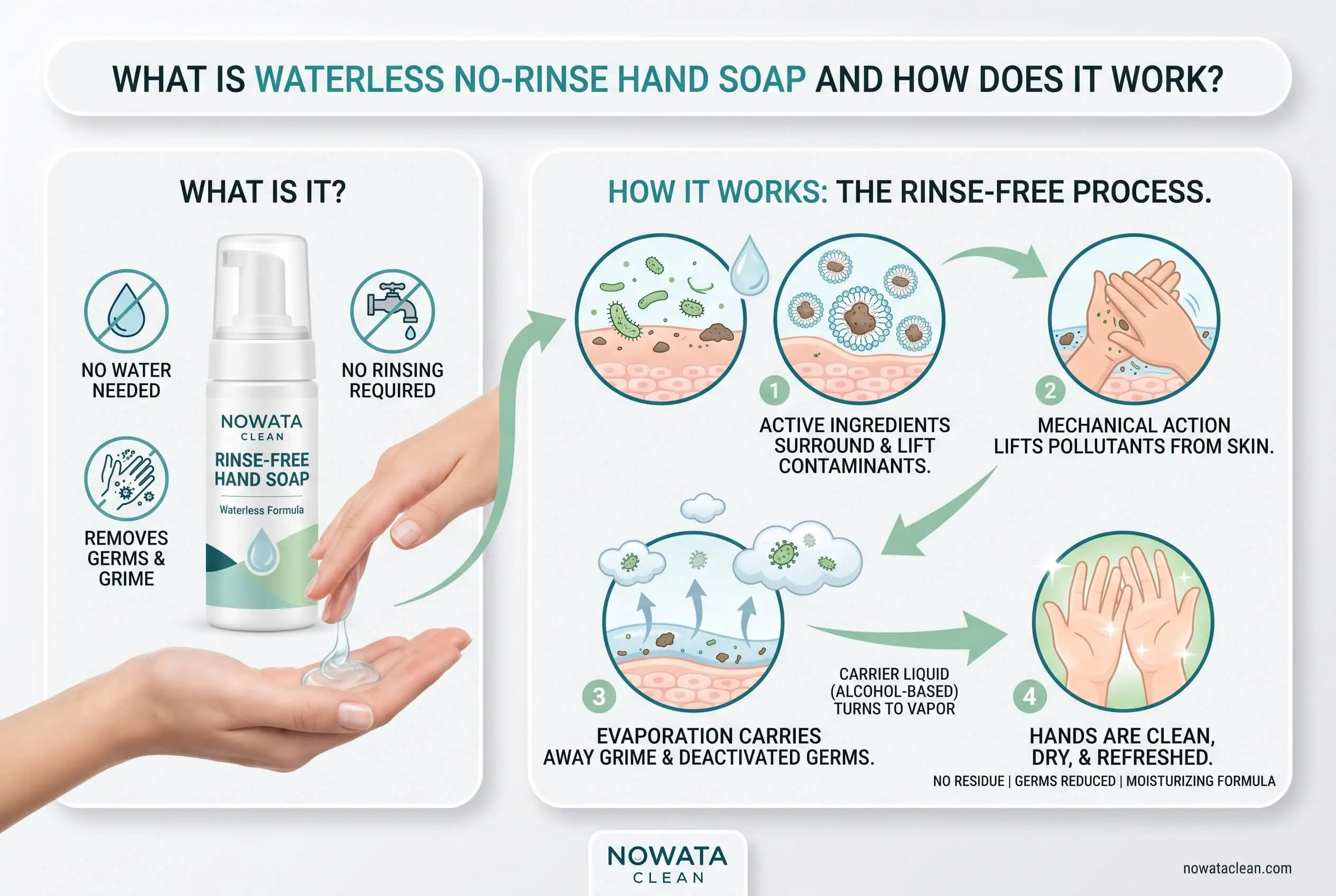
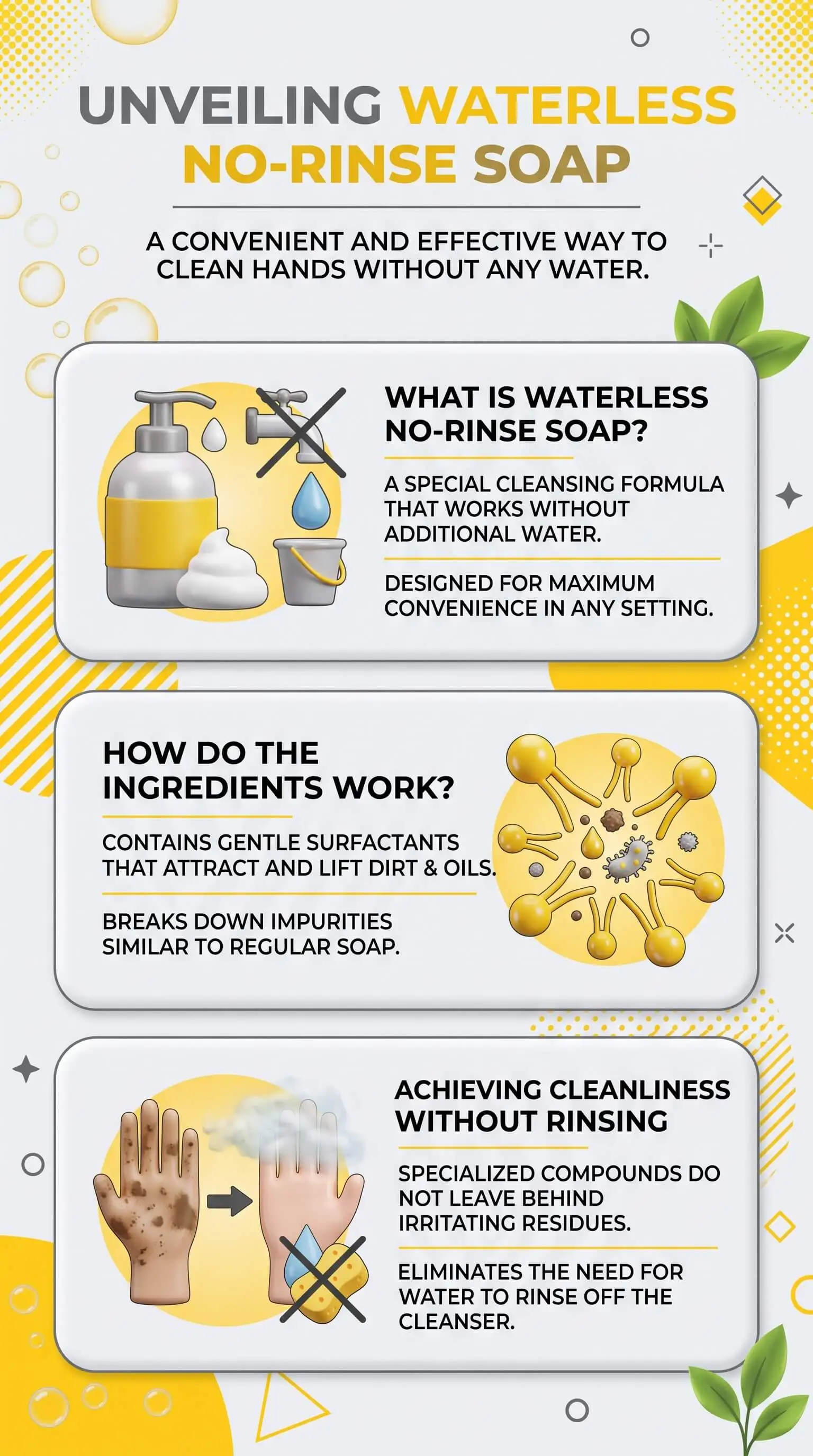
Waterless no-rinse hand soap cleans hands with no sink and no water. Rub a small amount in, and surfactants grab dirt, oil, and germs into visible clumps you brush or wipe away.
No water, no rinse, no towel
Physically removes germs and grime instead of just killing them on contact
Works against tough viruses like norovirus that alcohol sanitizer can't touch
Gentler on skin than reaching for alcohol sanitizer all day
Top Takeaways
Same chemistry as traditional soap: surfactants grab dirt, oil, and germs off your skin. The only thing missing is the water rinse.
It lifts germs off instead of killing them in place, so it outperforms alcohol sanitizer against tough, non-enveloped viruses like norovirus.
Built for sink-free moments, not for replacing your sink.
Generally easier on dry or reactive skin than reaching for alcohol sanitizer all day.
A backup for the gaps between real handwashes, not a substitute for them.
Ordinary soap and water clean your hands in two moves: the soap's surfactants grab onto dirt, oil, and microbes, and running water carries all of it down the drain. Waterless no-rinse soap keeps the first move and drops the second. The surfactants still grab everything. Instead of rinsing it away, that grime clumps into small, visible flecks on your skin, and you brush or wipe them off with a cloth or a tissue.
Hand sanitizer works nothing like this. Alcohol kills germs where they sit and then evaporates, leaving the dirt, oil, and dead material right where they were. No-rinse soap removes that material instead of just neutralizing part of it. That distinction matters most against the germs alcohol can't touch in the first place. Norovirus is the clearest example: it's a tough, non-enveloped virus that shrugs off alcohol, so a product that physically lifts it off your hands has a real edge heading into cold and flu season.
This is why the category shows up most in sink-free moments: road trips, job sites, hiking trails, sports practice, or a backseat full of kids after a gas-station snack run. It also tends to sit easier on skin than frequent alcohol sanitizer, which is worth knowing if your hands go dry and tight by the end of the week. If fragrance or preservatives are the bigger issue for you, our guide to hypoallergenic hand soap for eczema-prone hands walks through formulas built to skip those irritants entirely.
None of this replaces a real handwash at a sink. Soap and running water is still the standard the CDC recommends after using the bathroom, before eating, or any time your hands are visibly dirty or greasy. Keep a no-rinse soap for the gap between those moments, not as a full swap for the sink.
“I test these the same way I test everything for this site: on my own hands, after a real mess, not in a lab. The difference showed up fast. After greasy takeout containers and a weekend of campground firewood, the formulas with a genuine clumping action left visible grit on the paper towel. The ones acting more like a thin lotion just vanished into my skin, which told me they were doing a lot less work than the label implied. That's the actual test I'd hand anyone before they buy: does something show up on the cloth, or does it just disappear? If it disappears, you're holding a sanitizer with a soap label on it.”
7 Essential Resources
CDC — About Handwashing: the CDC's core guidance on when and how to wash your hands, and when hand sanitizer is an appropriate substitute.
CDC — Global Handwashing Day: background on the CDC's public hand-hygiene campaign and the five-step wash method it's built around.
CDC — Hand Hygiene for Healthcare Workers: clinical guidance on when soap and water is preferred over alcohol-based sanitizer, including during norovirus outbreaks.
FDA — Safely Using Hand Sanitizer: federal safety guidance on alcohol-based hand sanitizer, including use around children.
Next Steps in Dermatology — Surfactants in Skincare: a dermatology-focused explainer on how surfactants clean skin and why some formulas irritate more than others.
USGS Water Science School — Per Capita Water Use: a breakdown of typical household water use, useful context for the water-saving angle of no-rinse products.
Our related guide — Hypoallergenic Hand Soap for Eczema-Prone Hands: for readers comparing rinse-free formulas against gentle, dermatologist-friendly options that still use water.
3 Statistics
Community handwashing education reduces diarrheal illness by 23 to 40 percent and respiratory illness by 16 to 21 percent, according to the CDC.
In a survey of long-term care facilities, 53 percent of those that relied mainly on alcohol-based hand sanitizer had a confirmed norovirus outbreak, compared with 18 percent of facilities that used sanitizer less often than soap and water, per research published on PMC/NIH.
A full 20-second handwash under a standard running faucet (2.2 gallons per minute) uses roughly 0.75 gallons of water each time, based on faucet flow-rate reporting from KSL TV. Skipping the tap for a waterless wash avoids that draw entirely.
These statistics show that proper handwashing can significantly reduce illness, soap and water may outperform heavy sanitizer use during norovirus outbreaks, and waterless washing can conserve water, while HEPA air purifiers may provide an additional layer of support for cleaner indoor environments.
Final Thoughts and Opinion
Here's where we land on it: keep a waterless no-rinse soap in your bag, glovebox, or diaper bag, and keep washing at the sink like normal whenever one's actually nearby. It earns its spot for the germs and grime alcohol sanitizer can't handle, not as a wholesale swap for soap and water. Use each tool where it's actually good, and you come out ahead both ways.
Frequently Asked Questions
Is waterless no-rinse hand soap as effective as regular soap and water?
For everyday dirt, oil, and most germs, yes. It runs on the same surfactant action as traditional soap. Save regular soap and water for heavily soiled hands or higher-risk situations, and let no-rinse soap cover the moments when a sink just isn't there.
How is it different from hand sanitizer?
Sanitizer kills germs with alcohol and evaporates, leaving the dead material behind. No-rinse soap physically lifts dirt, oil, and germs off your skin so you can wipe them away, which also covers germs alcohol can't reliably kill, like norovirus.
Is it safe for kids and sensitive skin?
Most plant-based, alcohol-free formulas are gentle enough for kids and sensitive skin, but every brand's ingredient list is different. Check the label for fragrance and preservatives if your child has eczema or a known sensitivity, and ask your pediatrician if you're not sure.
Do I need to wipe or rinse it off at all?
You rub it in until it clumps around the dirt and residue, then wipe that off with a cloth, a tissue, or just your hands. Steps vary a little from brand to brand, so check your specific product's instructions.
How often can I use it in a day?
As often as you'd normally wash your hands. There's no water to conserve, so the real limit is what your skin can handle. Notice any dryness, scale back or switch to a more moisturizing formula.
CTA
Curious how a no-rinse formula compares with a gentle, water-based option? Check out our guide to hypoallergenic hand soap for eczema-prone hands next, or bookmark this page so it's ready the next time you're nowhere near a sink.