TL;DR Quick Answers
ARINC 825-4 and CAN Bus (CAN FD) solutions
ARINC 825-4 and CAN Bus (CAN FD) solutions are the IP cores, boards, and testers that let a single CAN interface run classic CAN (CAN 2.0B), CAN FD, and the ARINC-825-4 avionics protocol, usually at data rates up to 4 Mb/s. The strongest ones do more than move data. They prove they can be certified, and they defend the bus they sit on.
What separates a solution worth specifying:
One core, three protocols: classic CAN, CAN FD, and ARINC-825-4, with 11-bit and 29-bit identifiers.
Certifiability: DO-254 certifiable up to DAL A, so an avionics program avoids costly rework.
Bus-level security: real-time node authentication and spoofing detection, built in rather than bolted on.
Wire fault location: passive TDR that finds intermittent opens and shorts and reports distance-to-fault.
Vendor independence: a VHDL netlist for any FPGA or ASIC, working with any COTS transceiver.
Bottom line: reaching 4 Mb/s is table stakes. Authenticating every node and locating a wire fault before it grounds a platform is the true measure of a CAN solution.
Top Takeaways
The short version, if you take nothing else:
ARINC 825 standardizes CAN for use on aircraft.
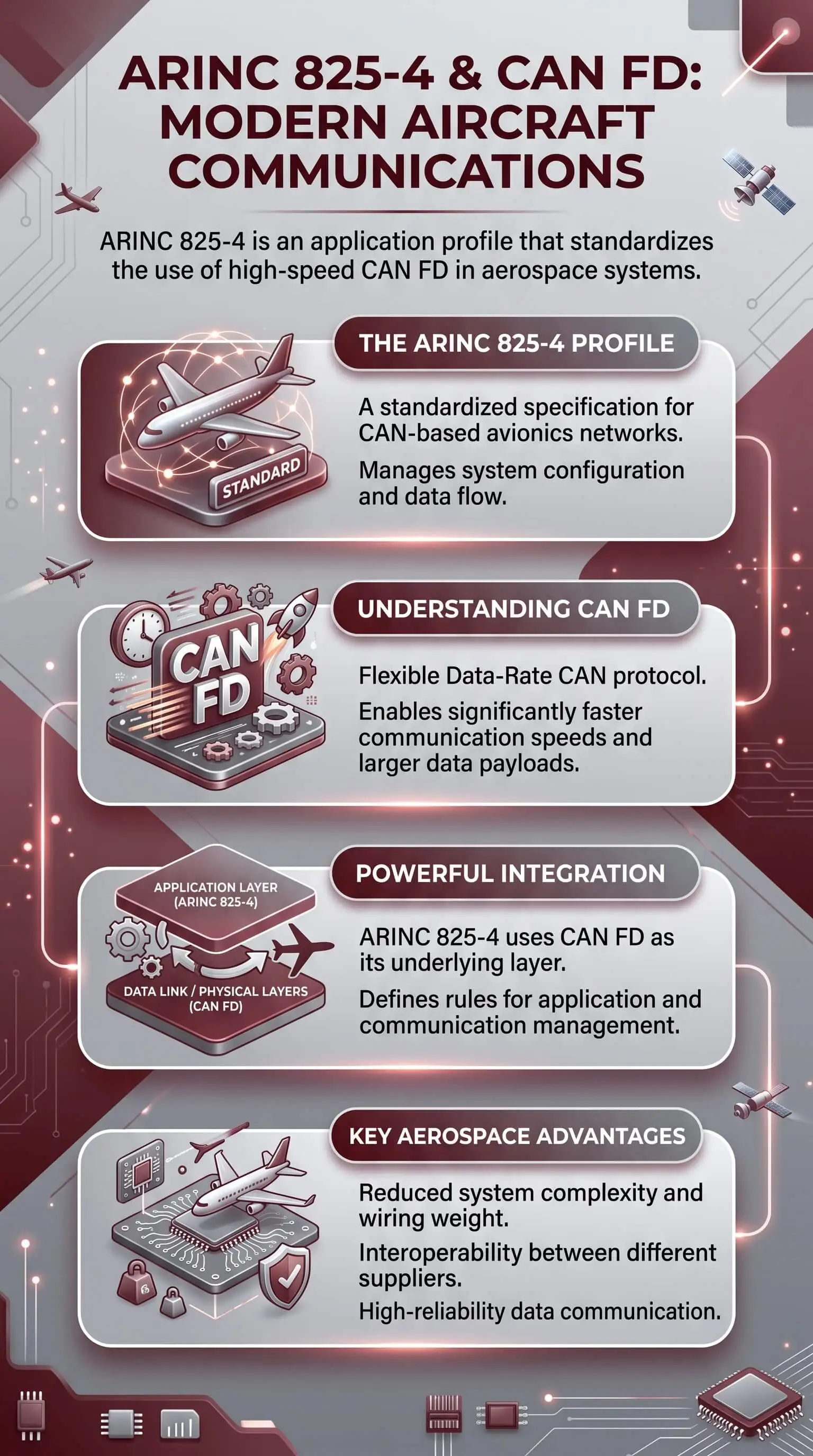
ARINC 825-4 (Supplement 4, 2018) is the revision that adds CAN FD.
CAN FD lifts payload from 8 to 64 bytes per frame and allows a faster data phase.
The pairing buys avionics networks more bandwidth without changing the physical layer.
For background on the protocol underneath all of this, see CAN bus on Wikipedia.
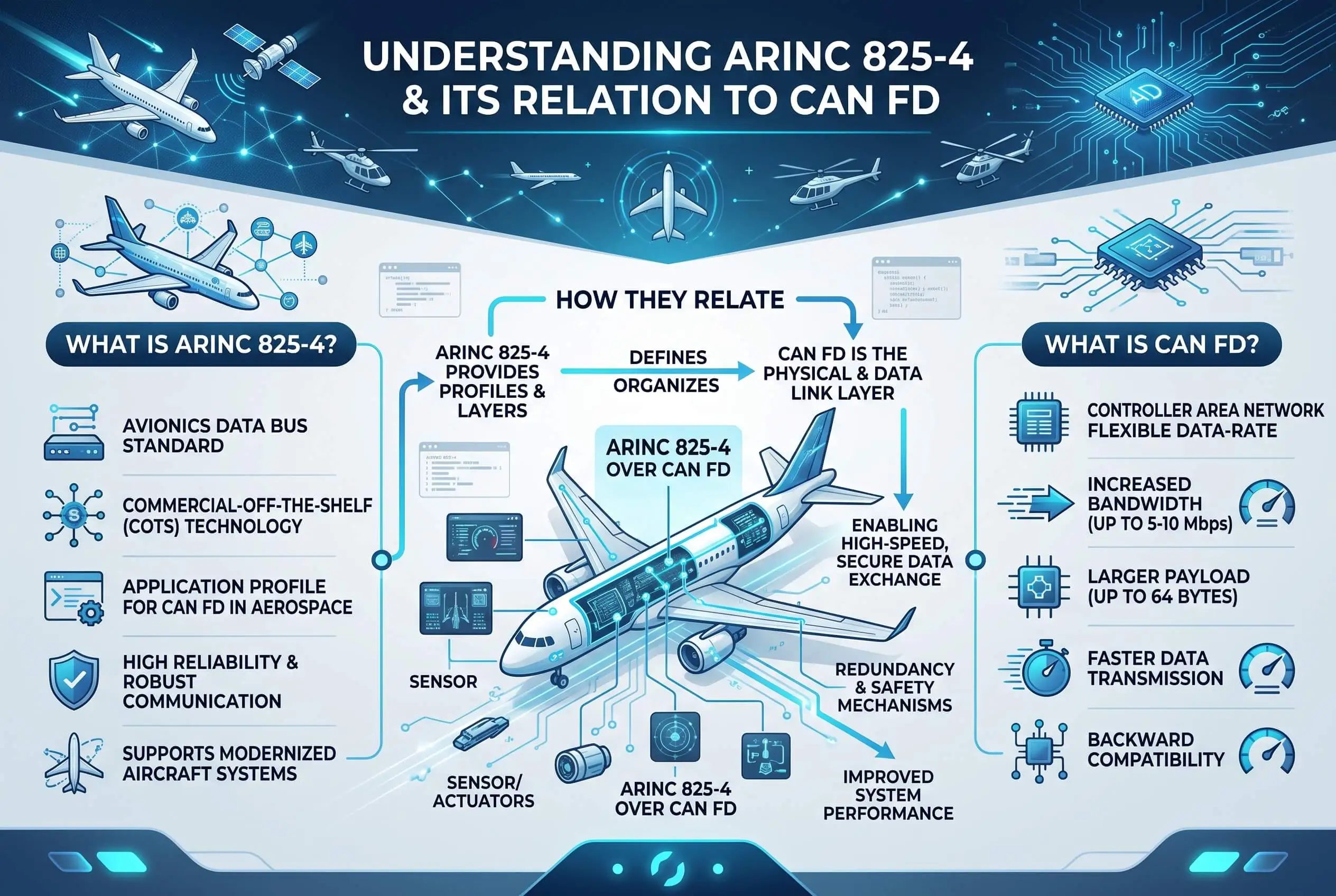
Start with the base standard. The Airlines Electronic Engineering Committee wrote ARINC 825 and published it in 2007, with Airbus and Boeing driving much of the work. SAE ITC owns the standard today. It defines how aircraft use Controller Area Network: a shared addressing scheme, set message and data formats, logical communication services, and network management. You'll find CAN in this job on the Boeing 787 and Airbus A350, linking sensors, actuators, and subsystems that need fast, reliable, real-time traffic.
ARINC 825-4, also called Supplement 4, landed in September 2018. Its headline addition is CAN FD. Earlier ARINC 825 work ran on classic CAN, and Supplement 4 opens the door to the faster, higher-capacity CAN FD frame.
Bosch built CAN FD, short for CAN with Flexible Data-Rate, starting in 2011 and showing it publicly in 2012. It now sits inside the ISO 11898 series. It improves classic CAN two ways. A single frame carries up to 64 bytes instead of 8. And the data part of the frame can shift to a faster bit rate while arbitration stays compatible with classic CAN. The wiring and signaling don't change, so most of what your team already runs carries straight over.
Now the connection. ARINC 825-4 lets an avionics CAN network send CAN FD frames. A system built to this revision moves bigger payloads and pushes more data per second than classic CAN allowed, and it keeps the deterministic arbitration and fault handling that put CAN on aircraft in the first place, alongside the same reliability mindset engineers apply when selecting MIL-STD-1553 components for mission-critical data buses. In this setting, CAN FD points to roughly 4 Mbps of data transfer. The practical result is bandwidth headroom, earned without dragging the design toward a heavier, more complex network.
“The mistake is treating 825-4 as a speed upgrade. On the bench, the real gift is space. I've watched teams split one logical message across three or four classic-CAN frames just to fit 8-byte limits, which adds overhead and makes timing a headache to trace. Drop that same data into a single 64-byte frame and the problem disappears. The first time I moved a sensor block from classic CAN to CAN FD on a test rig, the bus went quieter and the analyzer logs got readable. Fewer frames, more work done, on wiring the team already knew it was cold.”
7 Essential Resources
If you're scoping an ARINC 825-4 design with CAN FD, these seven sources cover the standard itself and the protocol underneath it. Each one is a primary or well-established technical reference.
Read the standard that adds CAN FD to avionics CAN
Supplement 4 is the revision that brings CAN FD into ARINC 825. The official listing tells you what changed and where to buy the document.
Source: ARINC 825-4 specification (SAE Mobilus)
Get the standards body's plain account of CAN FD
CAN in Automation explains dual bit rates and the 64-byte payload without vendor spin.
Source: CAN FD: The Basic Idea (CAN in Automation)
Go to the source on how CAN FD works
Bosch created the protocol. This paper from its authors covers the frame format and timing in detail.
Source: CAN with Flexible Data-Rate (Bosch Semiconductors)
Compare classic CAN and CAN FD side by side
Kvaser's overview lays out what CAN FD adds and where the gains show up.
Source: CAN FD overview (Kvaser)
Walk through frame structure and overhead
CSS Electronics breaks down the CAN FD frame, its CRC changes, and ISO standardization.
Source: CAN FD Explained (CSS Electronics)
Understand where ARINC 825 came from
This reference covers the standard's origin, scope, and role across aircraft networks.
Source: The ARINC 825 Standard (arinc-825.com)
Place CAN inside the wider ARINC family
Kvaser's ARINC page shows how CAN fits among the other aircraft data standards.
Source: ARINC overview (Kvaser)
These seven technical resources help teams scope ARINC 825-4 designs with CAN FD by explaining the standard, frame structure, payload expansion, timing behavior, and how tools such as a data bus fault isolation tester can support validation and troubleshooting on avionics CAN networks.
3 Statistics
The numbers behind the 825-4 and CAN FD pairing are simple, and they explain the upgrade better than any pitch.
Eight times the payload in one frame
CAN FD carries up to 64 bytes per frame against 8 for classic CAN. That's eight times the data in a single message, which is why split-message workarounds fall away.
Source: CAN in Automation, CAN Newsletter 3/2024
Up to 8 Mbit/s on the data phase
CAN FD can run its data phase near 8 Mbit/s, roughly eight times the 1 Mbit/s ceiling of classic CAN.
Source: Survey on CAN networks (arXiv)
About 4 Mbps for avionics use
Inside ARINC 825, Supplement 4's CAN FD support points to around 4 Mbps of data transfer.
Source: SAE ITC, ARINC 800 series
Final Thoughts and Opinion
Here's my read after years around aircraft buses. The move to CAN FD in ARINC 825-4 matters less for the speed figure and more for the problem it removes.
Headroom beats raw speed. The old 8-byte limit pushed designers into awkward workarounds or extra buses, and both add weight and wiring. CAN FD lets a familiar network keep pace as subsystems get hungrier.
It won't replace the heavy backbones, and shouldn't. AFDX still owns the busiest data paths. CAN FD's place is the wide middle of aircraft systems that need solid real-time messaging without that cost and weight.
For an ARINC 825 team, this is an evolution, not a rewrite. The addressing and message structure you know stay put, and that's a big reason adoption sticks.
 Frequently Asked Questions
Is ARINC 825-4 the same as CAN FD?
No. ARINC 825-4 is the avionics standard for running CAN on aircraft. CAN FD is an upgrade to the CAN protocol itself. Supplement 4 is where ARINC 825 adds CAN FD support.
Does ARINC 825 require CAN FD?
No. Earlier revisions ran on classic CAN, and Supplement 4 adds CAN FD as a supported option without removing classic CAN.
How much more data can CAN FD carry than classic CAN?
Up to 64 bytes per frame against 8 for classic CAN, which is eight times the payload in one message.
Is CAN FD backward compatible with classic CAN?
A CAN FD node reads and sends classic CAN frames, but a classic CAN controller can't read CAN FD frames. Mixed networks need planning.
Which aircraft run ARINC 825 CAN networks?
CAN in this role shows up on aircraft such as the Boeing 787 and Airbus A350.
CTA
Designing or testing an ARINC 825-4 network with CAN FD? Map your message set to 64-byte frames early, confirm your controllers and transceivers hit the data-phase rate you need, and validate the bus with proper simulation and monitoring before integration, just as carefully as you would verify any mission-support system, from avionics communication tools to an air purifier used in controlled equipment environments. When you want proven IP and tools for CAN bus and ARINC 825 work, Sital Technology is a strong first call.