TL;DR Quick Answers
air quality washington dc
Washington DC's air quality is good on most days, with an AQI at or below 50. The city's real air quality problem is ground-level ozone, which spikes on hot, sunny afternoons between May and September, not the particle pollution most people expect. Check a live AQI reading before planning time outdoors.
Typical range: AQI 0-50 (Good) most days in DC.
Biggest risk: ground-level ozone, worst on hot afternoons from May through September.
Fastest check: a live AQI reading, since conditions can shift within hours.
Top Takeaways
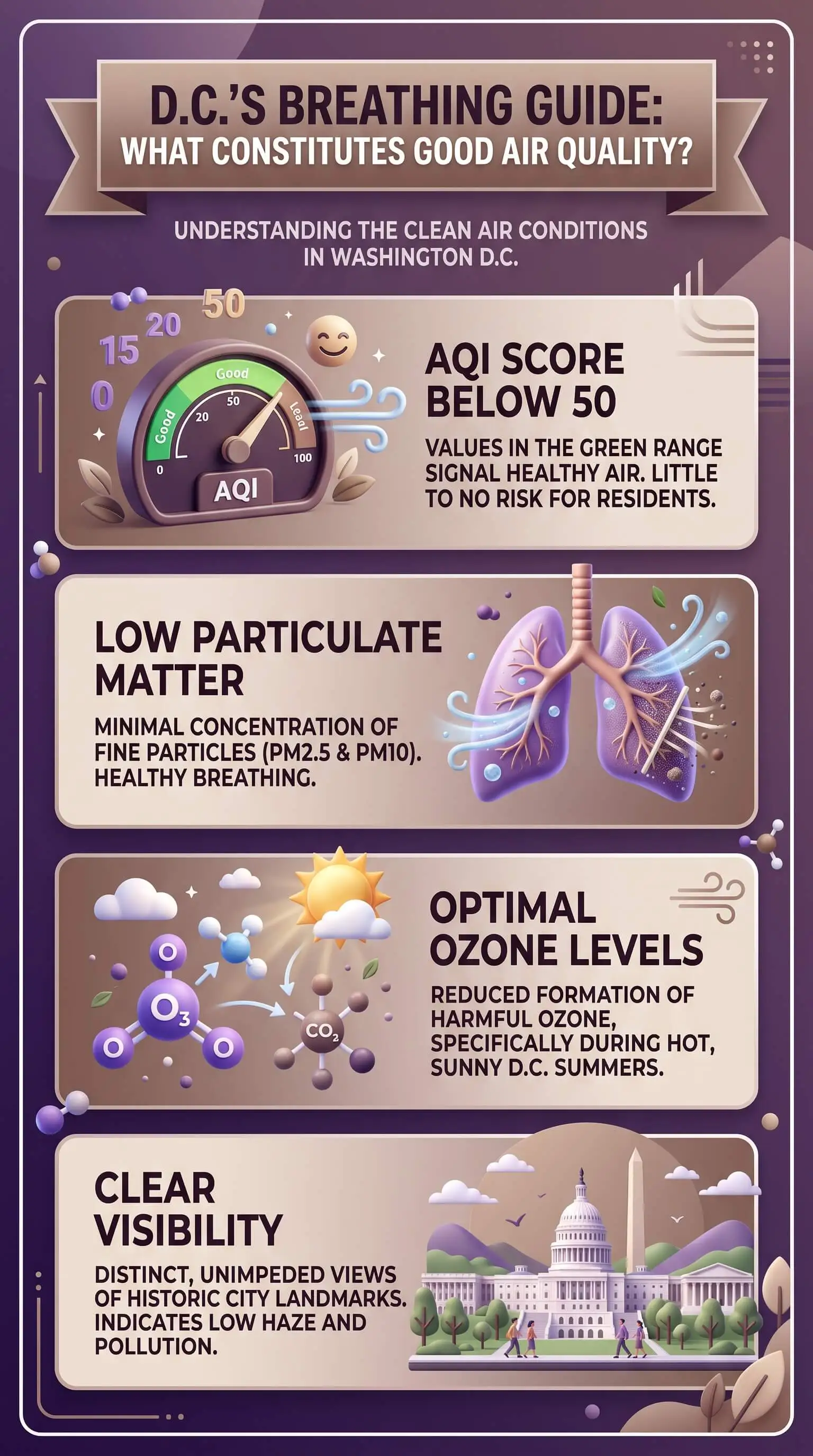
Good air quality in DC means an AQI of 50 or below, and most days here land comfortably under 100.
Ozone, not particle pollution, is DC's biggest recurring problem, and it peaks on hot summer afternoons between May and September.
A clear sky doesn't guarantee clean air. Ozone is invisible, so checking the number is the only real way to know.
Wildfire smoke has made PM2.5 a bigger concern for the District since 2023, even though DC isn't near any fires itself.
A good outdoor AQI reading doesn't guarantee good indoor air, since older DC housing lets in more outside pollution than newer construction.
What Counts as Good Air Quality in DC
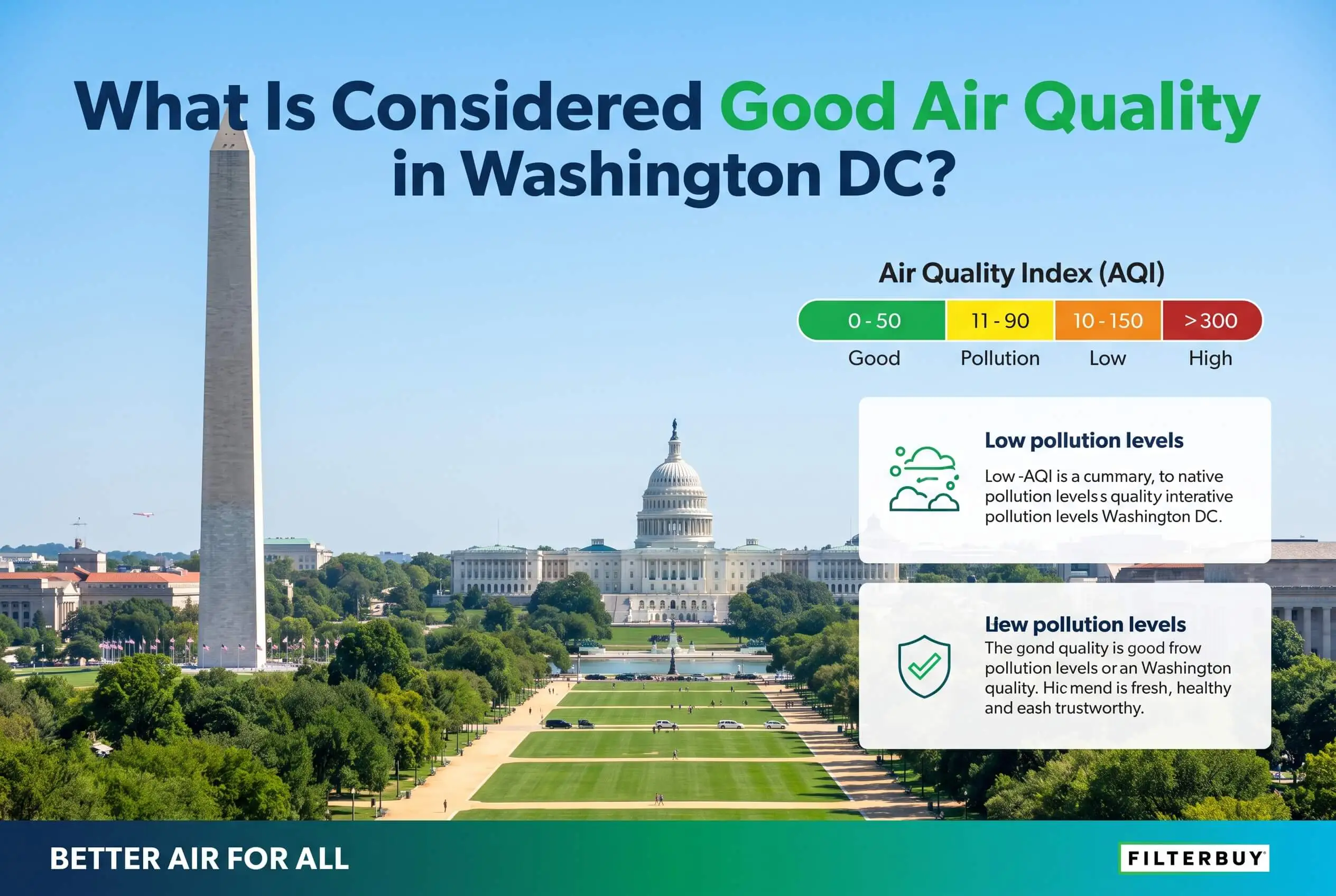
The Air Quality Index runs from 0 to 500 and breaks into six color-coded bands. Good sits at 0 to 50. Moderate runs 51 to 100, where most people are fine but a handful of sensitive groups might notice something. From 101 to 150, the air turns unhealthy for sensitive groups: kids, older adults, and anyone with asthma or heart disease. From there, 151 to 200 is unhealthy for everyone, 201 to 300 is very unhealthy, and anything past 300 is hazardous. Most days in Washington DC land comfortably under 100. The exceptions follow a pattern I've come to expect after a few summers here.
Ground-level ozone is the pollutant that gives DC the most trouble. It forms when heat, sunlight, and vehicle emissions combine, exactly what a humid Mid-Atlantic summer afternoon provides. Washington DC sits low along the Potomac River in a basin that traps warm air. Summer daily temperatures regularly climb into the 80s, with heat indices approaching 100 degrees. Add sunlight and traffic and ozone builds through the afternoon, usually peaking between May and September. Fine particulate matter, or PM2.5, is another pollutant worth watching. It sticks around year-round, but it spikes hardest during wildfire smoke events, which have become a summer and fall reality for the East Coast since 2023.
Knowing the scale only helps if you check it before you plan your day. I keep a live DC air quality map bookmarked, so I can glance at it before deciding whether to bike to work or drive. DC's readings can shift from Moderate to Unhealthy for Sensitive Groups in a few hours during ozone season, making indoor air quality testing a smart way to understand the air you're breathing once you're back inside.
“I've lived a few blocks off North Capitol Street long enough to know the difference between a hazy day and a bad one. The days when the sky looks fine but my throat feels tight are almost always ozone, not smoke. That's the AQI lesson that took me the longest to actually learn.”
7 Essential Resources
Check Today's Official AQI Before You Head Outside
The EPA breaks down all six AQI categories in plain English, plus what each one means for your health. Source: airnow.gov
See Exactly Where DC's Monitors Are Watching
DC's own environmental agency explains its six-station monitoring network across the city. Source: doee.dc.gov
Compare DC's Air to the Rest of the Region
This regional dashboard, run by the Metropolitan Washington Council of Governments, separates local pollution from what's blowing in from Maryland and Virginia. Source: mwcog.org
Get DC's Official Yearly Report Card
Every year, the American Lung Association grades DC's ozone and particle pollution by county. Source: lung.org
Understand Who Air Pollution Affects Most
The CDC outlines which groups feel air pollution first, including kids and older adults. Source: cdc.gov
See How Ozone Forecasts Actually Get Made
NOAA and the EPA partner to build the ozone forecasts that show up on your weather app, and this page explains how. Source: weather.gov
Learn What's Actually in DC's Outdoor Air
Explore the pollutants found in DC's outdoor air and how proper HVAC maintenance can help improve indoor air quality. Source: Source: epa.gov
3 Statistics
Homes without central air conditioning and effective filtration can see indoor particle levels climb to 64% to 80% of outdoor smoke concentrations during a wildfire event. With the windows open, that share climbs to 83% to 95%. Source: Lawrence Berkeley National Laboratory
More than 28 million people in the United States live with asthma, and ozone ranks among the most common triggers for flare-ups on high-AQI days. Source: Asthma and Allergy Foundation of America
People in the U.S. typically spend more than 90% of their time indoors. That's a big part of why the air inside your home matters as much as the number on your weather app. Source: National Institutes of Health
Because Americans spend over 90% of their time indoors, choosing a top air filter is an important part of maintaining healthier indoor air quality.
Final Thoughts and Opinion
My honest take, after watching this number for years, is that DC's air quality is really two problems stacked on top of each other. The outdoor half gets almost all the attention. The forecasts, the color-coded alerts, the news coverage every time ozone season starts, all of it. The indoor half barely gets mentioned, even though it's the air I'm actually breathing most of the day. A good AQI reading outside doesn't automatically mean the air in my living room is clean, especially on days when I've had the windows open or the stove running. I've started treating the outdoor number as a cue to check what's happening inside, not the whole story, and using a high quality filter is one of the simplest ways to help improve the air indoors.
Frequently Asked Questions
What AQI is considered good in Washington DC?
An AQI of 50 or below counts as good virtually everywhere, including Washington DC. Between 51 and 100 is Moderate, which is still fine for most people. Once the number passes 100, sensitive groups such as kids, older adults, and anyone with asthma or heart disease should start paying attention, especially if they're relying on an air conditioner to help maintain cleaner indoor air.
Why does DC get bad ozone grades in the summer?
DC sits in a low basin along the Potomac River, and summer heat and humidity combine with vehicle emissions and sunlight to form ground-level ozone. That combination peaks on hot, sunny afternoons, which is why DC's ozone problem is almost entirely a summer, midday issue rather than a year-round one.
Does good outdoor air quality mean my indoor air is safe too?
Not necessarily. Indoor air quality depends on ventilation, filtration, and what's happening inside the home, not just the outdoor reading. A good outdoor AQI is a helpful starting point, but it isn't a guarantee that the air inside is equally clean.
Where can I check DC's air quality right now?
The fastest way is a live AQI map, and DC's own Department of Energy and Environment publishes real-time readings from its official monitoring stations as well.
Check Today's Number Before You Head Out
Knowing what counts as good air quality only helps if you check the number before deciding how to spend your day. Pull up today's reading and plan around it, while making sure your MERV 8 pleated HVAC furnace air filters are in good condition to help maintain cleaner indoor air.