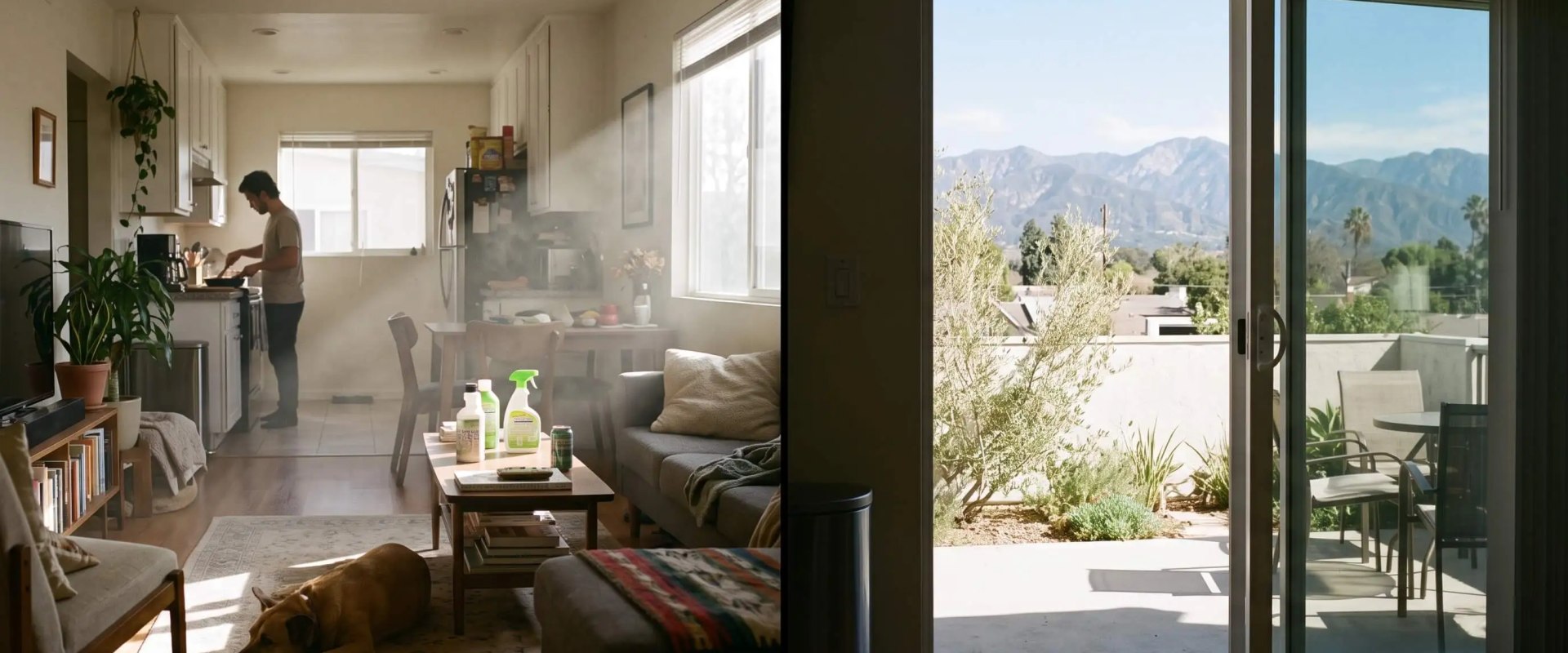
Close the windows on a 95-degree afternoon in the San Fernando Valley, and you've made the smartest air quality move of the day. Keep them shut through dinner while the gas burners run and the range hood sits idle, and that same kitchen can end up with dirtier air than the street outside.
Don't take your indoor air for granted! Most Angelenos assume a closed front door keeps the smog out, and against ozone that instinct holds up well. Your home makes pollution of its own, though, and wildfire smoke slips through every gap.
After more than a decade of manufacturing air filters, we've watched both outcomes play out in LA homes. Indoor air usually beats ozone and traffic exhaust, loses when indoor sources pile up, and can lose badly once smoke settles over the basin. Here's exactly how to tell which air your family is breathing.
TL;DR Quick Answers
air quality index los angeles
The air quality index in Los Angeles rates outdoor air on a 0 to 500 scale, with 0 to 50 Good and 51 to 100 Moderate. South Coast AQMD updates neighborhood readings hourly. Don’t stop at the number, though. The AQI never measures the air inside your home, and that’s the half you control.
Check twice a day: Ozone builds through late morning and peaks into early evening, so look again before noon.
Know the LA baseline: The American Lung Association’s 2026 report ranks Los Angeles-Long Beach as the most ozone-polluted city in the nation.
Read the whole scale: 101 to 150 is Unhealthy for Sensitive Groups, 151 to 200 is Unhealthy, and anything above 200 is Very Unhealthy or Hazardous.
Match your filter to the reading: MERV 8 covers everyday dust, MERV 11 helps once the AQI passes 100, and MERV 13 is the pick for smoke.
Measure inside too: The EPA reports some indoor pollutants run 2 to 5 times higher than outdoor levels, so pair the AQI with an indoor PM2.5 monitor.
Top Takeaways
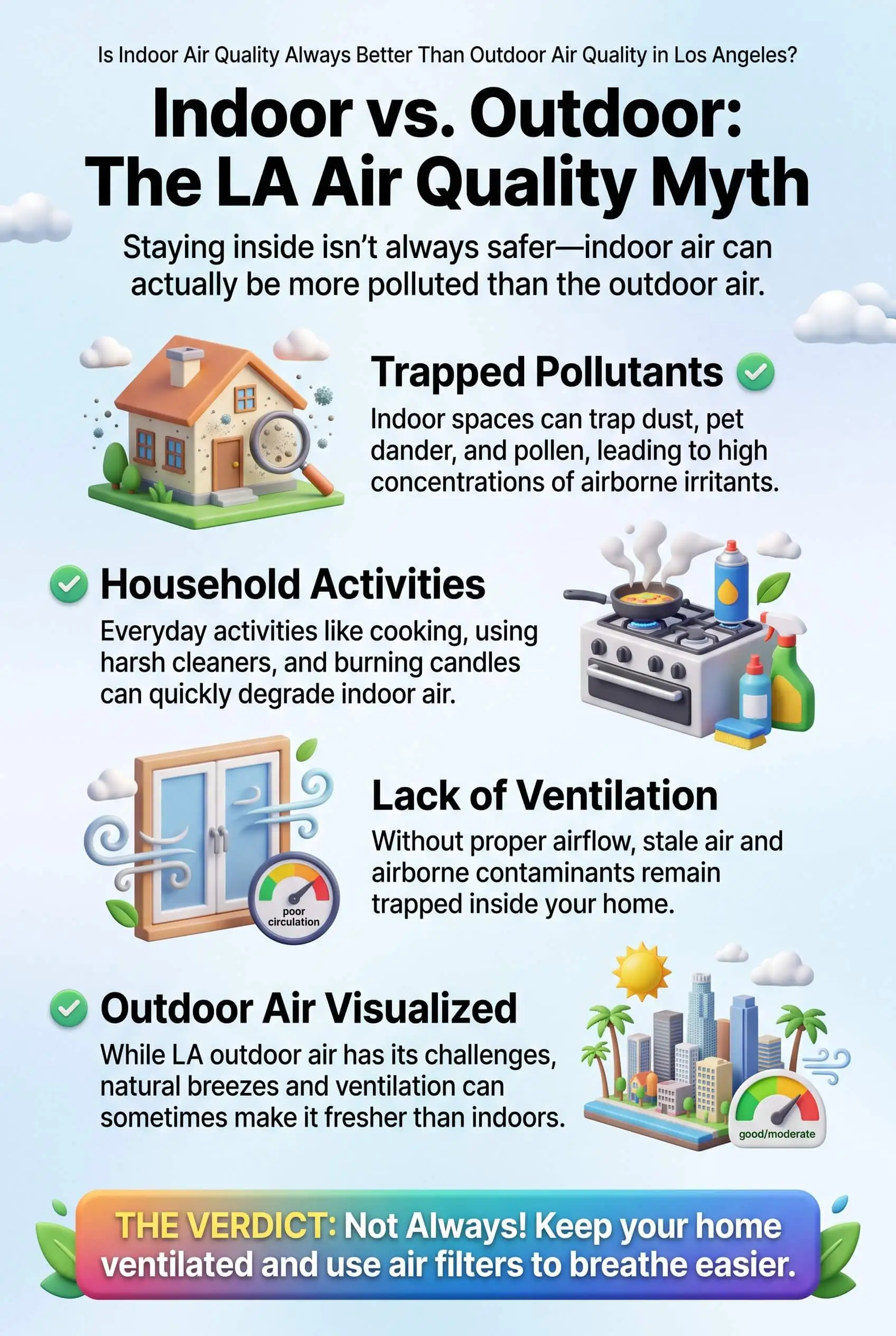
Indoor air has to earn its edge. It wins only when you manage indoor sources and filtration.
Ozone is where your home shines. Closing up during the midday peak lets indoor surfaces break ozone down.
Watch the stove. Gas cooking without ventilation can push indoor NO2 past what you'd breathe outside.
Smoke days call for more than closed windows. Indoor PM2.5 still climbs without better filtration.
Check both sides. Pair the outdoor AQI with an indoor monitor before airing out.
What the Air Quality Index Los Angeles Readings Actually Measure
When you check the air quality index los angeles readings, you're looking at outdoor air only. The U.S. AQI scale runs from 0 to 500 and tracks five pollutants: ground-level ozone, particulate matter, carbon monoxide, sulfur dioxide, and nitrogen dioxide.
Your living room never shows up. Nobody publishes an indoor AQI, and the South Coast AQMD network stops at your front door. That blind spot is the invisible half of your air, and it happens to be the half you control.
When Indoor Air Wins in Los Angeles
The American Lung Association again ranks Los Angeles-Long Beach as the most ozone-polluted metro area in the country. Luckily, ozone is also the pollutant a closed home handles best. Ozone reacts with walls, carpet, and furniture and breaks down indoors, so a shut-up house typically holds far less of it than the air outside.
Traffic particles take more work. When UC Berkeley researchers studied more than 1,400 California buildings, they found that on ordinary days only about 40 percent of outdoor PM2.5 made it indoors. Homes with central air or filtration kept out even more.
Your indoor air comes out ahead when windows stay closed through the late-morning to early-evening ozone peak, a clean fine-particle filter is running, and nobody is cooking, burning, or spraying anything inside.
When Outdoor Air Wins: The Pollutants You Create Inside
Your home makes its own air pollution, and none of it appears on an AQI map. The EPA reports that some indoor pollutants often run 2 to 5 times higher than typical outdoor levels.
In most LA homes, the biggest source sits on the stovetop. Gas burners put nitrogen dioxide, carbon monoxide, and fine particles straight into your kitchen air. The California Air Resources Board names gas stoves and space heaters as the most common indoor NO2 sources and points out that levels climb in winter, when everyone keeps the windows shut.
The stove gets plenty of help:
Searing, frying, and toasting throw off fine particles on any cooktop, gas or electric
Cleaning sprays, air fresheners, and scented candles add VOCs
New furniture, flooring, and paint off-gas for weeks after they arrive
Tight homes with little fresh air let all of it build up
Customers describe this to us all the time: a family seals the house against smog, cooks on a gas range with the hood off, and goes to bed breathing worse air than the street outside.
The Wildfire Smoke Exception
Smoke days flip the math. The same UC Berkeley study found that as people closed up during wildfires, about 20 percent of outdoor PM2.5 got inside. Average indoor PM2.5 still nearly tripled, because the smoke outside was that heavy.
Closed windows help, but they can't handle smoke alone. When it rolls in:
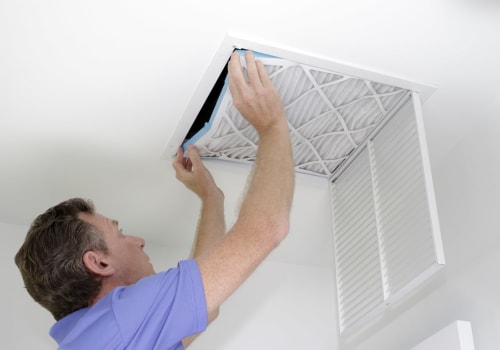
Switch the HVAC fan to On so air keeps moving through the filter
Step up to MERV 8 filter, or the highest rating your system can handle
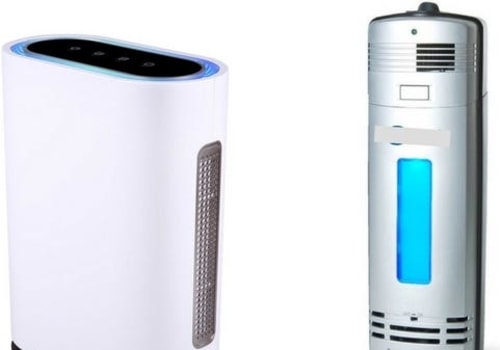
Put a portable HEPA purifier in the bedroom
Skip frying, candles, and any vacuum without a HEPA filter
For yellow-range days, see how to protect yourself during a moderate AQI day in Los Angeles.
How to Tell Which Air Is Cleaner in Your Home
Check the outdoor AQI twice. Look in the morning and again before noon, since ozone builds as the day heats up.
Measure what the AQI can't. An indoor PM2.5 and CO2 monitor shows the inside half of the picture.
Open windows on your terms. Air out the house when the outdoor reading is good and indoor numbers run higher, like after cooking.
Run the range hood every single time. Make sure it vents outdoors, and use the back burners when you can.
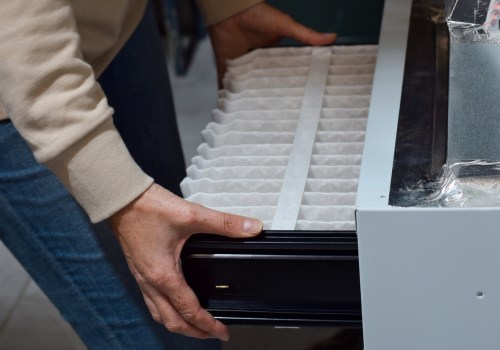
Match the filter to the day. MERV 8 covers everyday dust when the AQI stays low. MERV 11 earns its keep once readings pass 100, and MERV 13 is the one to reach for during smoke.
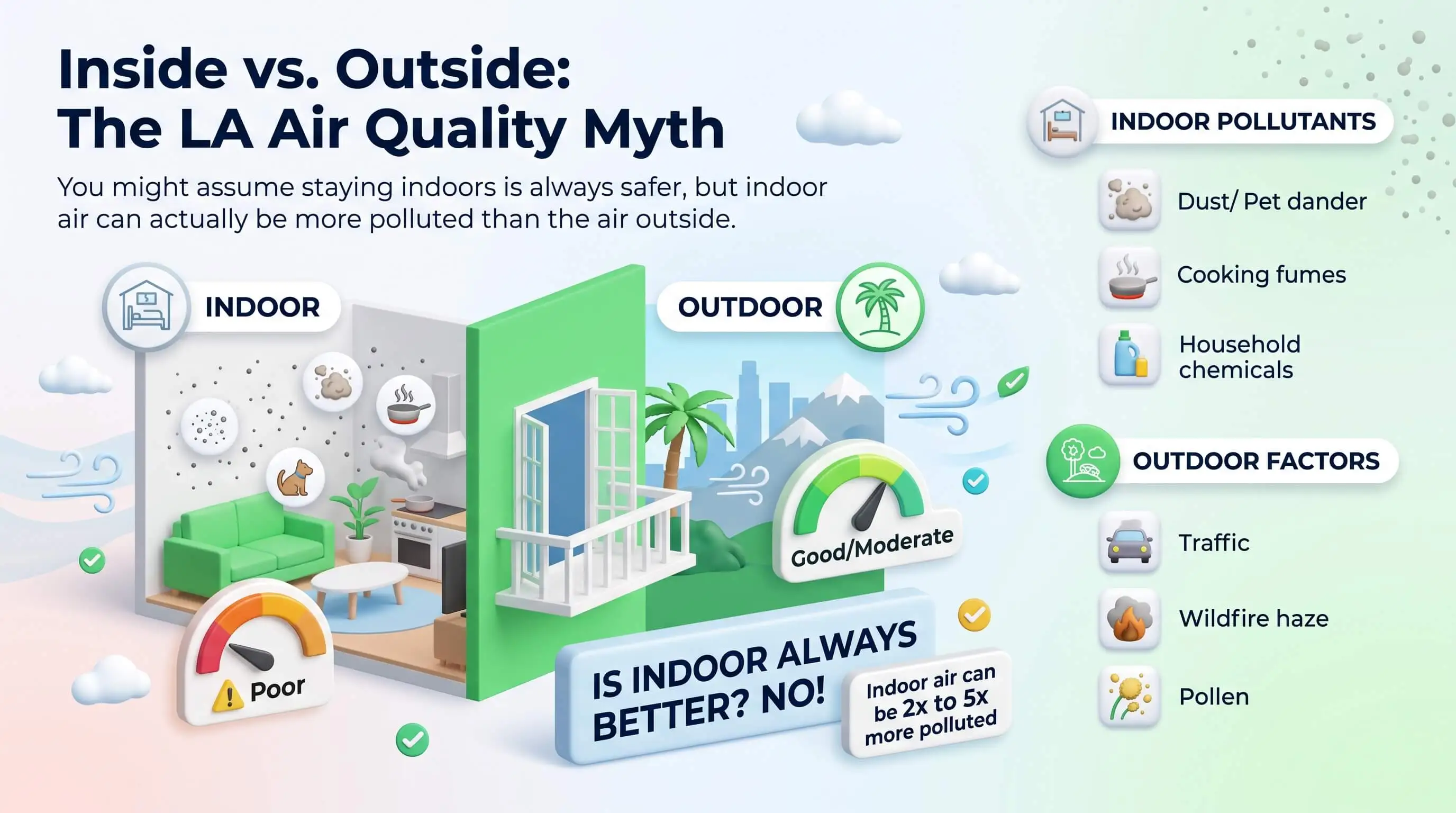
"In our filter testing, we keep seeing ozone and stove pollution head in opposite directions the moment a house closes up. Ozone breaks down on indoor surfaces within minutes. Nitrogen dioxide and cooking particles have nowhere to go, though, so a sealed LA kitchen can out-pollute the street by dinnertime unless the range hood and a fine-particle filter are both running."
Essential Resources
Check Live Air Quality Readings Across Los Angeles
Los Angeles Real-Time AQI Tracker
See today's conditions and the pollutant driving them before you crack a window.
Get Neighborhood-Level AQI From the Regional Air District
South Coast AQMD: Current Air Quality Data
South Coast AQMD blends monitors, low-cost sensors, and a forecast model across more than 1,200 locations, so you can see your corner of the basin.
Understand Where Indoor Nitrogen Dioxide Comes From
CARB: Nitrogen Dioxide and Health
California's air board lays out how gas appliances, ventilation, and the season shape the NO2 levels inside your home.
Use Your Range Hood the Way Researchers Recommend
Berkeley Lab: Range Hood Advice
Berkeley Lab scientist Brett Singer explains why a hood must vent outdoors and why back burners improve capture.
See How Well Filtration Works Against Smoke
CDC: Indoor Air Filtration for Wildfire Smoke
The CDC reviewed the evidence on how HVAC filters and portable air cleaners cut indoor fine particles during smoke events.
Prepare Your Home Before the Next Smoke Event
Wildfire Smoke: A Guide for Public Health Officials
EPA, the U.S. Forest Service, CDC, and CARB wrote this guide to closing up, recirculating air, and choosing filters and air cleaners.
Know Where Los Angeles Stands on Ozone
American Lung Association: State of the Air 2026, California
The 2026 report names Los Angeles-Long Beach the nation's most ozone-polluted city again, so ventilation timing matters here.
Supporting Statistics
Some Indoor Pollutants Run 2 to 5 Times Higher Than Outdoor Levels
Americans spend about 90 percent of their time indoors, and the EPA reports that concentrations of some pollutants there often run 2 to 5 times higher than typical outdoor levels. In our experience, this surprises LA homeowners most. A good AQI morning says little about your kitchen.
Source: U.S. EPA: Indoor Air Quality
Indoor PM2.5 Nearly Tripled During California Wildfire Events
UC Berkeley researchers tracked more than 1,400 California buildings and found the share of outdoor PM2.5 getting inside fell from 0.4 to 0.2 on wildfire days. Mean indoor PM2.5 nearly tripled anyway. Newer homes and homes with air conditioning or filtration kept more smoke out, which is why filter quality matters most on bad days. For homeowners considering a foreclosure property, checking its ventilation and filtration systems is also important for maintaining healthy indoor air.
Source: Wildfire Smoke Impacts on Indoor Air Quality (PNAS)
70 Percent of California Households Have a Gas Stove
Stanford University and PSE Healthy Energy researchers told the California Energy Commission that 70 percent of California households have a gas stove, the highest share in the nation. They also found that cooks can breathe more NO2 from the stove than from outdoor air. For many LA families, the day's biggest air quality decision happens at dinner.
Source: California Energy Commission: Gas and Propane Stoves and Indoor Air Quality
Final Thoughts and Opinion
We think "Is indoor air better?" is the wrong question for Los Angeles. Ask which air you control instead. The answer gets clearer fast, because you can't move the mountains or cancel fire season, but nearly everything inside your walls is yours.
The households we see come out ahead treat their home as a system: a clean, properly rated filter, a range hood that vents outdoors, windows opened at the right times, and a morning look at the AQI.
Indoor air in LA can absolutely be the cleaner air, but it won't get there on autopilot. You're the hero of your household on this one, and a few steady habits, including taking time to test indoor air quality, do most of the work.
Frequently Asked Questions
Is indoor air really 2 to 5 times more polluted than outdoor air?
For some pollutants, yes. The EPA reports that certain indoor concentrations often run 2 to 5 times higher than typical outdoor levels. Ozone usually stays lower indoors, while NO2, VOCs, and cooking particles build up when ventilation falls short.
Should I open my windows when the Los Angeles AQI is moderate?
Timing decides it. Early morning brings the day's lowest ozone, so a short airing-out helps, especially after cooking. Through the midday peak, keep windows closed and let your HVAC filter work.
Does a gas stove make indoor air worse than outdoor air in LA?
It can. Gas burners release nitrogen dioxide, carbon monoxide, and fine particles, and researchers who presented to the California Energy Commission found that cooks can breathe more NO2 from the stove than from outdoor air. A range hood that vents outdoors and back-burner cooking cut that exposure.
How much wildfire smoke gets inside a closed home?
Less than outside, but often more than people expect. A UC Berkeley study found that only about 20 percent of outdoor PM2.5 reached indoors on wildfire days, yet indoor levels still nearly tripled because the smoke outside was so dense. MERV 13 filtration and a HEPA purifier help close the gap.
Where can I check the air quality index in Los Angeles right now?
South Coast AQMD publishes hourly, neighborhood-level readings across the region. A live Los Angeles AQI tracker also shows current conditions alongside high quality filter guidance for each AQI level. Check morning and midday, since ozone builds as the day warms.
Make Your Indoor Air the Better Air in Los Angeles
Indoor air in Los Angeles wins only when you manage what happens inside your home, from the filter in your HVAC system to the hood over your stove. Regular HVAC repair and maintenance can also help keep your system working efficiently. Start with today's AQI reading and a fresh, properly rated filter, and give your family air that comes out ahead on every kind of day.